
• Skip to primary navigation
  • Skip to main content
  • Skip to primary sidebar
Gluten-Free Baking logo
  • Home
  • Recipes
  • About
    • About Me
    • Contact
    • My Cookbooks
    • Work with Me
menu icon
go to homepage
  • Home
  • About
  • Recipes
  • Contact
    • Facebook
    • Instagram
  • search icon
    Homepage link
    • Home
    • About
    • Recipes
    • Contact
    • Facebook
    • Instagram
  • ×
    Home

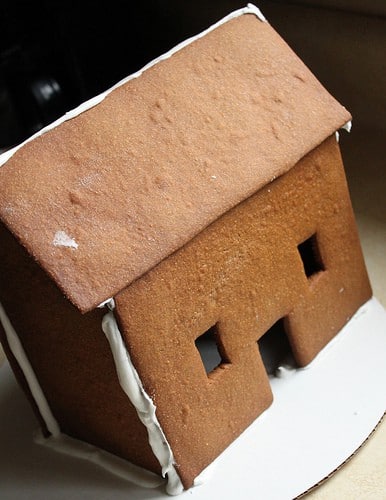
    How to Make a Gluten-Free Gingerbread House

    Gluten-free gingerbread house.

    Gluten-free gingerbread house.

    If you have children, this project is wonderful. If you don’t have children, this project is wonderful. There’s just one thing to remember.

    It takes time.

    And that’s a good thing! The time it takes to make the dough, assemble the house, and decorate means lots of talking and laughing.

    On, and there’s one other thing to remember.

    Don’t stress about it.

    No matter what it looks like, your gingerbread house will be perfect. Why? Because it’s yours. It doesn’t need to be blog-worthy or magazine-worthy or anything else. So what if the roof dips a little? If the candy looks gaudy. It’s a gingerbread house. It’s should be fun. Remember that.


    And…remember to laugh and eat candy while you put it together. It’s good for the soul, I promise.


    Ready to make a gluten-free gingerbread house?

    Here’s how it’s done:

    You’ll Need
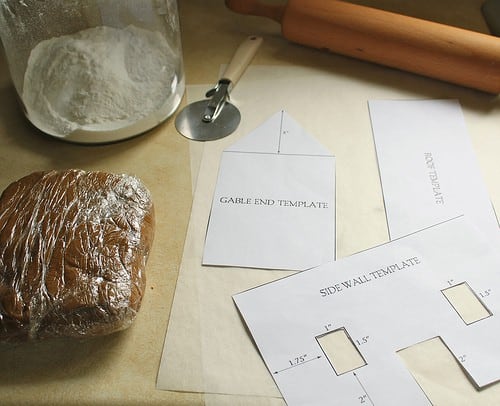
     

    Template and dough for gluten-free gingerbread house.

    gingerbread dough (recipe below)

    pizza cutter

    parchment paper

    rimmed baking sheet

    Gingerbread House Template (this is a PDF download)

    rolling pin

    cake cardboard

    royal icing (recipe below)

    piping bag

    pasty tip (half-inch round)

    candy, if desired
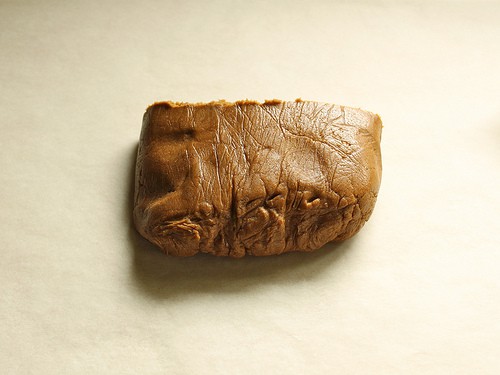
     

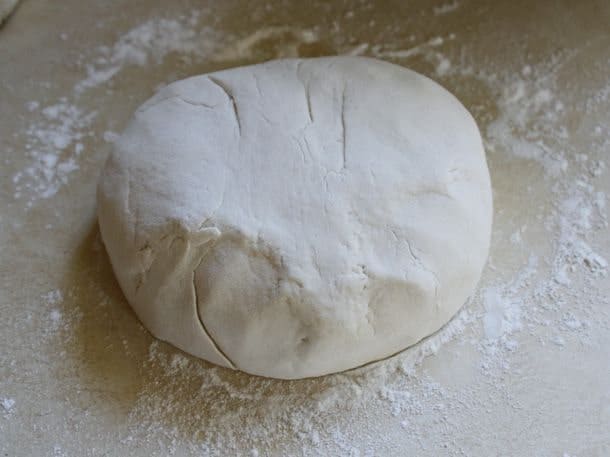
    Gluten-free gingerbread dough for gingerbread house.

    Divide the one of the dough round in half.  Center the dough on a piece of parchment paper.
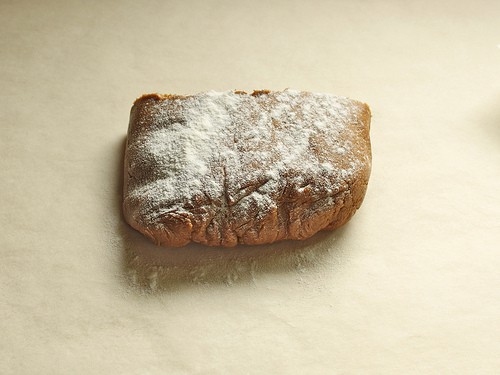
     

    Gluten-free gingerbread dough dusted with white rice flour.


    Lightly dust the dough with white rice flour.
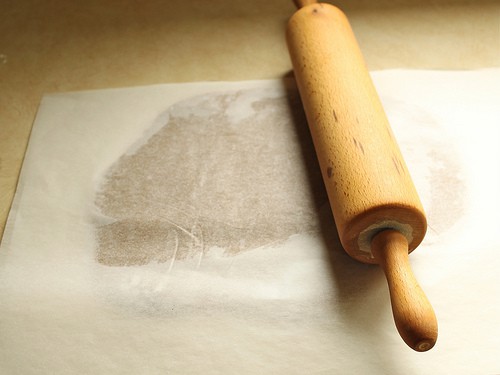
     

    Gluten-free gingerbread dough between two pieces of parchment paper.


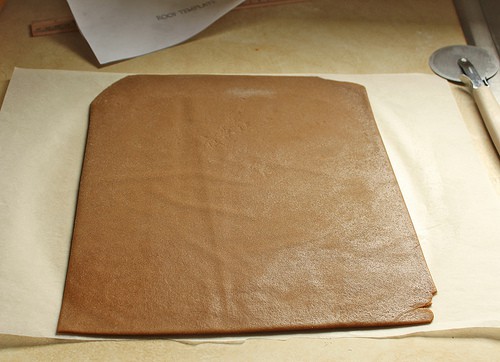
    Cover the dough with parchment paper and roll dough out until it’s about  1/4-inch to 1/2-inch thick. Don’t worry if your dough is a wee bit larger than the paper. You can take care of that in a second.
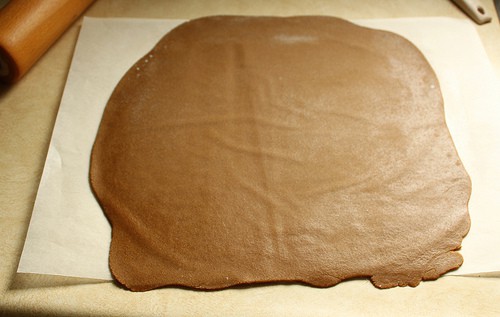
    Gluten-free gingerbread dough rolled out.


    Remove the top piece of parchment.


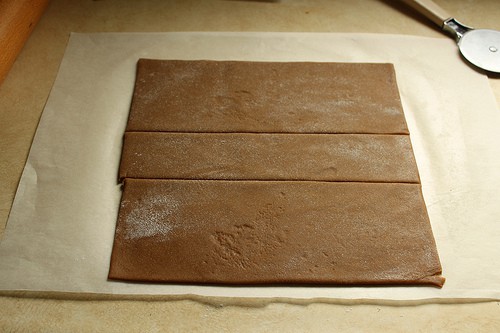
    Gluten-free gingerbread dough rolled out and trimmed into a large square.


    Use a ruler and pizza wheel to trim the edges of the dough.
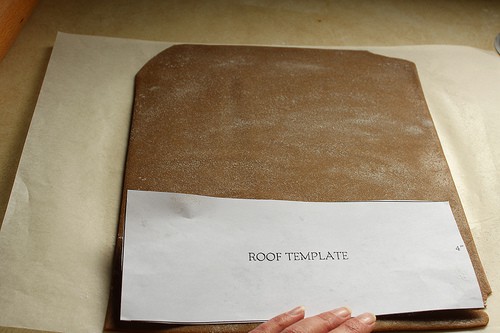
     

    Roof template on gluten-free gingerbread cookie dough.


    Lightly dust the dough with white rice flour. (This prevents the paper template from sticking to the dough.) Place the template on the dough. Cut with your pizza wheel.
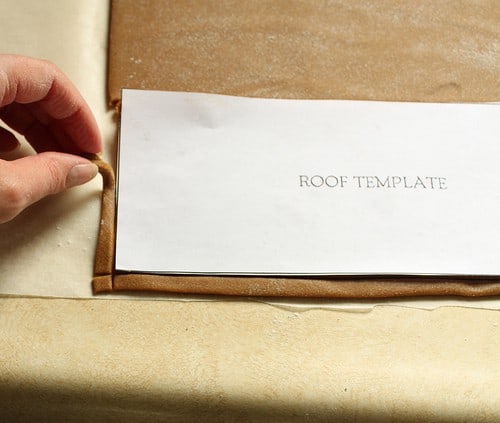
     

    Pulling gluten-free gingerbread cookie dough away from roof template for gingerbread house.


    Pull excess dough away.


    Gluten-free gingerbread dough cut into three rectangles.


    For this piece (I’m working with the roof pieces here.), there was excess dough between the two roof pieces. You want to remove this extra dough.
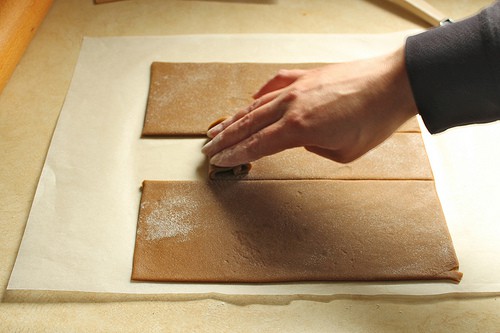
     

    Dough cut for gluten-free gingerbread house.


    Roll the dough away, if needed.


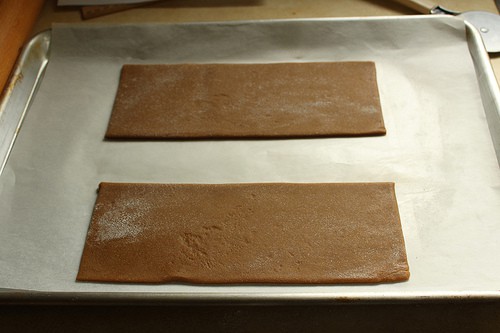
    Two pieces of dough for gluten-free gingerbread house.


    Quickly slide the parchment, with the gingerbread pieces, onto a baking sheet. By sliding the parchment onto the baking sheet, you won’t disturb the cut outs, ensuring they are the correct shape for assembling your house later on in the process.
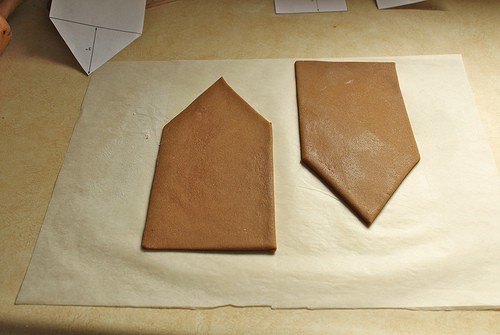
     

    Side house pieces for gluten-free gingerbread house.


    Repeat. Here are the sides of the house.
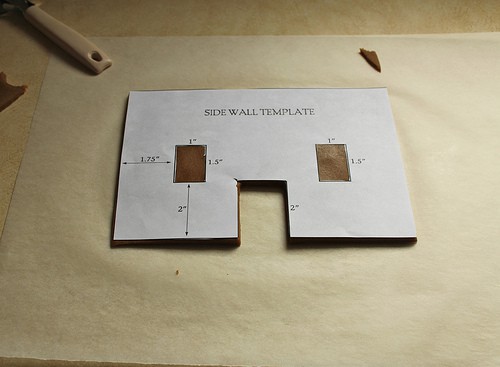
     

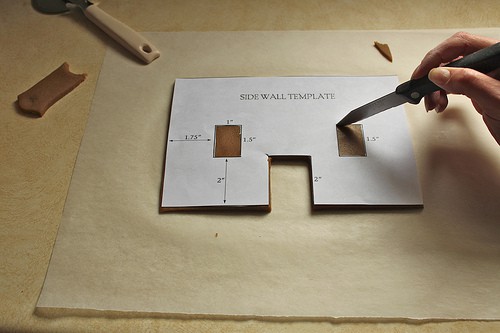
    Side wall template on gluten-free gingerbread house dough.


    And the front.


    Cutting window into dough for gluten-free gingerbread house.


    Use a small knife to cut any windows or doors.
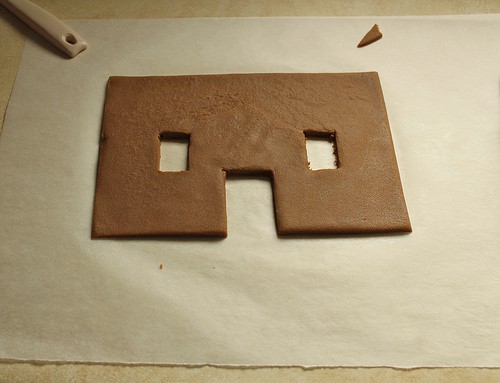
     

    Front wall for gluten-free gingerbread house.


    Remove all templates.


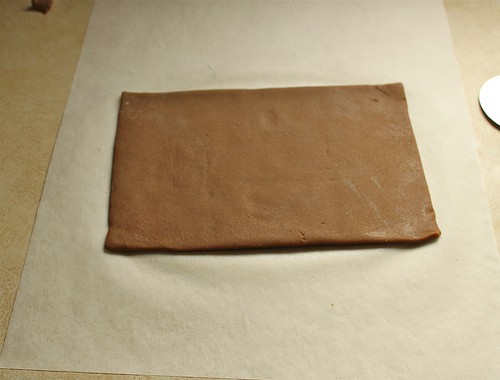
    Rectangle of gluten-free gingerbread cookie dough on parchment paper.


    For my house, I wanted the back windowless. This is just a preference. So for this piece, I used the same template I used for the front of the house but I didn’t cut in windows or a door.


    Bake gingerbread pieces. Allow to cool completely.
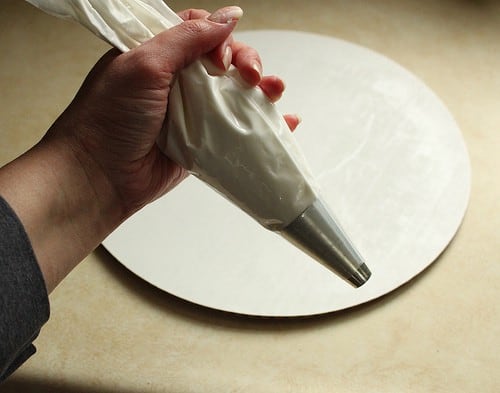
     

    Pastry bag filled with royal icing for gluten-free gingerbread house.


    Place royal icing in a pastry bag fitted with a large round tip.
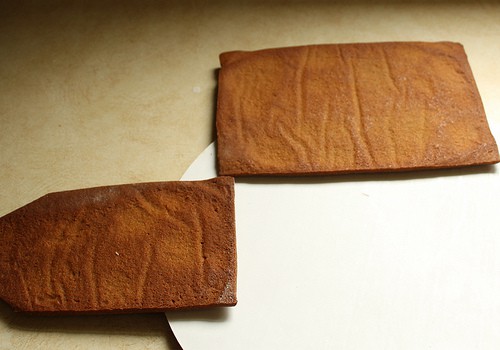
     

    Back wall and side wall baked pieces for a gluten-free gingerbread house.


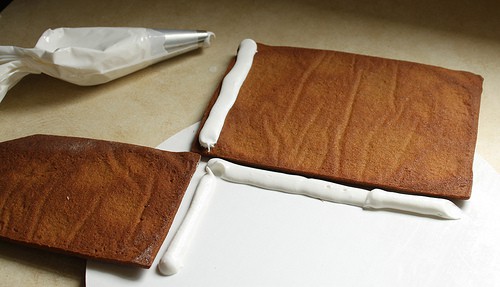
    Decide where you want to place the house on the cardboard. Lay the back and one side of the gingerbread on the cardboard (face down).
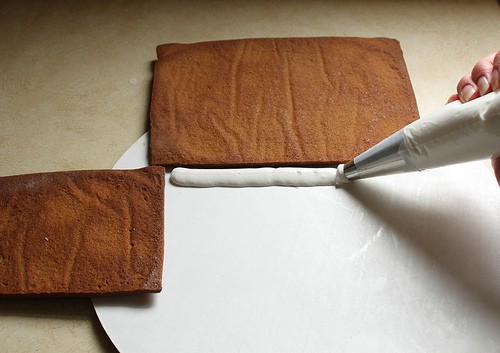
     

    Piping royal icing beneath baked gluten-free gingerbread house wall.


    Pipe royal icing along the cardboard below the gingerbread pieces. This ribbon of royal icing helps hold the house up.
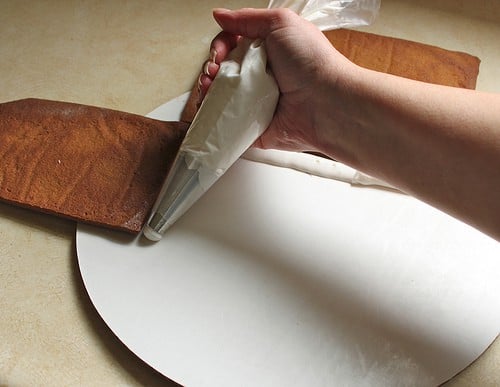
     

    Piping frosting on white cardboard to secure a gluten-free gingerbread house.


    Repeat under the side wall.


    Laying out gluten-free gingerbread house with frosting.


    Pipe a ribbon of icing along the edge of the gingerbread back wall.
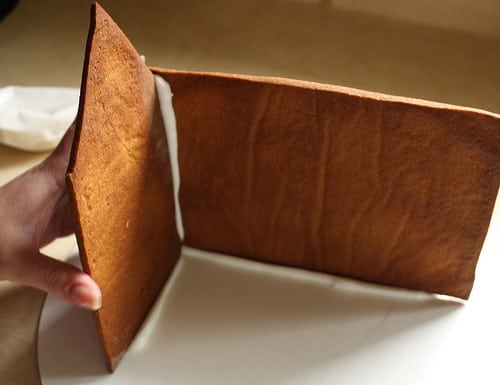
     

    Placing side and end of gluten-free gingerbread house together.


    Stand the gingerbread pieces up (centering them in the royal icing you pipped on the cardboard). Hold the back and side wall together for a minute.
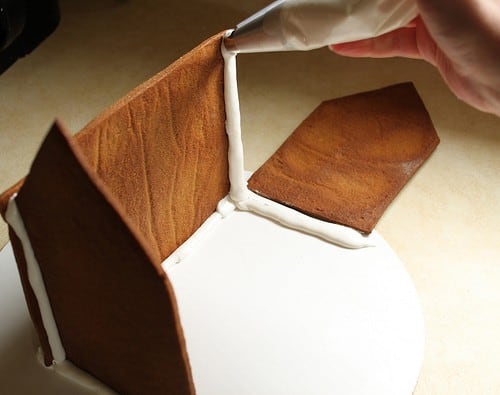
     

    Frosting the edges of a gluten-free gingerbread house.

    Repeat for the side wall. Pipe another ribbon of icing on the cardboard and one on the side of the back wall.
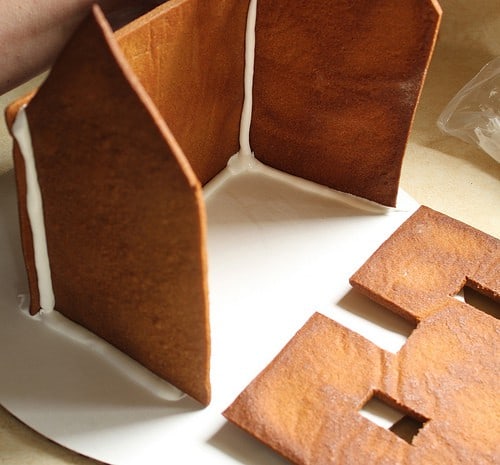
     

    Putting together a gluten-free gingerbread house.


    Stand up side wall. Hold for a moment.
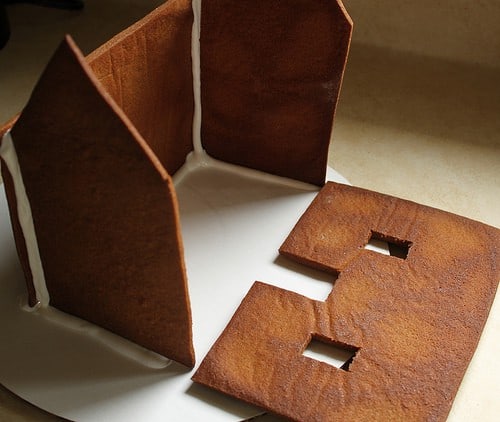
     

    Putting together gluten-free gingerbread house.


    Center the front of the house. (Again, the gingerbread piece should be face down.)
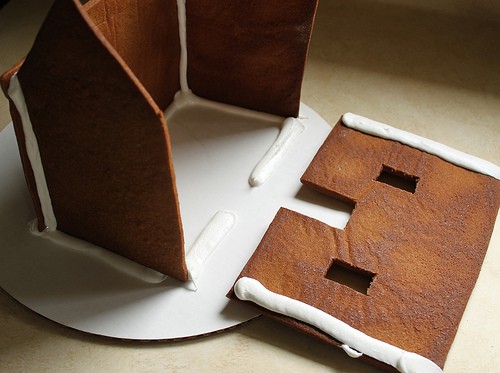
     

    Putting together a gluten-free gingerbread house with frosting.


    Pipe icing on the cardboard and along the edges of the wall. Stand up front wall.
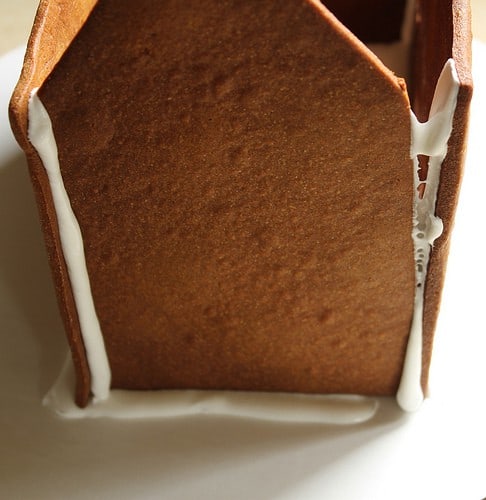
     

    Gluten-free gingerbread house with gap on right wall.


    Inspect the house. See this space? We need to fix this.
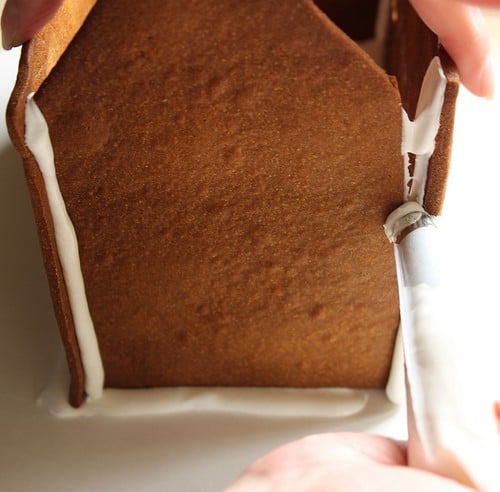
     

    Placing icing on sides of gluten-free gingerbread house.


    Use your piping bag to squeeze icing into any space between the gingerbread pieces.
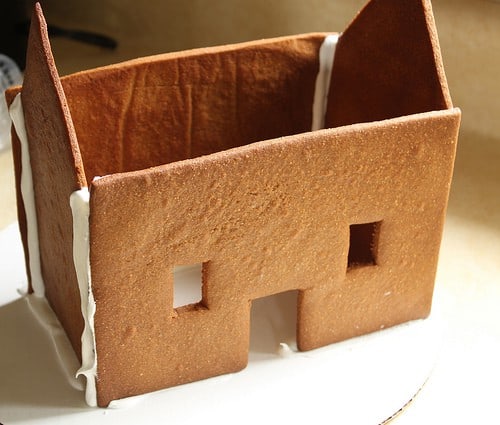
     

    Gluten-free gingerbread house with no roof.

    Allow icing to dry for an hour or so. If you put the roof on before the walls are dry, the entire house can fall apart.
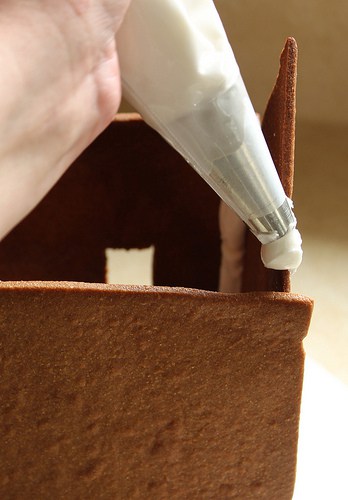
     

    Placing icing on gluten-free gingerbread house.


    Pipe icing along the edge of the side walls.
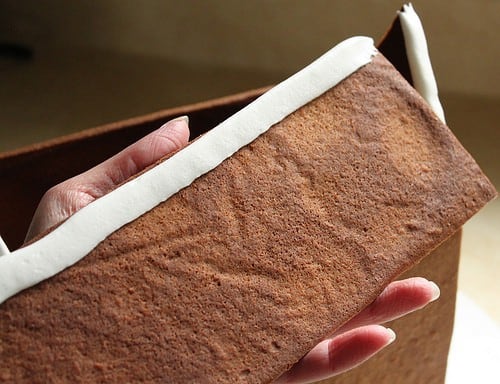
     

    Gluten-free gingerbread roof with icing on the top edge.


    Pipe icing along the top of the roof piece.
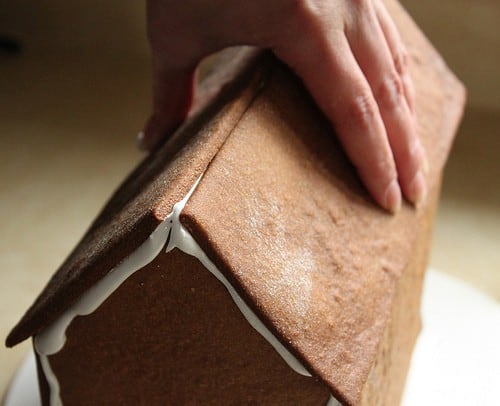
     

    Placing roof on gluten-free gingerbread house.


    Position roof. Hold in place for a moment.


    Gluten-free gingerbread house.


    Allow the house to dry. (Ignore my thumbprint on the roof. It adds…character!) Now you have a blank canvas. Have fun creating your house. Add candy. Colored icing. Leave it alone and just enough the scent of gingerbread! There’s no wrong way to decorate a gingerbread house.

    FAQ

    My gingerbread house fell apart! 

    Two things could have happened: 1. Your icing might have been too wet. 2. Your area might be humid. Too much water, either in the icing or in the environment can cause a house to collapse.

    My roof wants to slide off!

    You really need to hold it in place for a few minutes. If you are unable, you can try to find something tall enough and wide enough to place under the roofline to prop up the roof piece while it dries.

    Can we eat it?  

    …yes. I hesitate because it’s a very dry gingerbread. If you want a tasty gingerbread, I suggest making a recipe for homemade gingerbread men.
    Template and dough for gluten-free gingerbread house.
    Print

    Gluten-Free Gingerbread House

    Prep Time 1 hour
    Cook Time 45 minutes
    Total Time 1 hour 45 minutes
    Servings 1 house
    Author GlutenFreeBaking.Com

    Ingredients

    For the Gingerbread House

    • 3 cups brown rice flour (15 ounces; 425 grams)
    • 1 1/4 cups white rice flour (5 ounces; 142 grams)
    • 1 cup sweet rice flour (4 ounces; 113 grams)
    • 1/2 cup cornstarch (2 ounces; 56 grams)
    • 1 tablespoon ground ginger
    • 2 teaspoons ground cinnamon
    • 1/2 teaspoon ground allspice
    • 2 teaspoons xanthan gum
    • 1 cup vegetable shortening, melted (6 1/2 ounces; 192 grams)
    • 1/4 cup water, plus more as needed (2 ounces; 56 grams)
    • 1 1/2 cup unsulphered molasses (12 ounces; 340 grams)
    • 1 cup granulated sugar (7 ounces; 198 grams)

    Royal Icing

    • 3 tablespoons Meringue Powder
    • 4 cups powdered sugar (16 ounces; 453 grams)
    • 6 tablespoons warm water (3 ounces; 85 grams)

    Instructions

    1. In bowl of stand mixer, whisk together brown rice flour, white rice flour, sweet rice flour, cornstarch, ginger, cinnamon, allspice, and xanthan gum. In small bowl, whisk together melted shortening, water, molasses, and granulated sugar. Stir until smooth.

    2. Pour wet ingredients over dry ingredients. Fit mixer with flat paddle attachment. Mix, on medium speed, until a thick dough forms. If dough is very dry, add a tablespoon or more of additional water.
    3. Lightly white rice flour your counter. Turn dough out onto the counter. Pat into a large round. Cut in half. Wrap each half in plastic wrap. Chill overnight. (Or, if you are in a rush, chill at least five hours.)
    4. Preheat oven to 375 degrees F.
    5. Cut out the template for the house. Set aside.
    6. Divide dough in half. Place one half of the dough on a piece of parchment paper. Sprinkle the dough lightly with white rice flour. Cover with a second piece of parchment paper. Roll out dough to 1/4 inch thickness.
    7. Remove top piece of parchment paper. Trim dough into a rectangle. Place the template on the dough. Follow the template with a pizza cutter or sharp knife. Remove excess dough from between the pieces. (Be sure to keep similar size on each pan. If you bake a large piece along with a small piece, the small piece will burn before the large piece is done.)
    8. Bake dough until aromatic, about 15 minutes.
    9. Repeat with remaining templates and dough. Re-rolling dough as needed.
    10. Allow gingerbread pieces to cool.
    11. Make royal icing
    12. In bowl of stand mixer, whisk together meringue powder and confectioners' sugar. Add water. Beat, using flat paddle attachment, until icing is stiff, about seven minutes. Icing should be stiff and shiny. Cover bowl of icing with a damp (not wet) paper towel to prevent a sugary crust from forming on the icing.
    13. Place the royal icing in a bag fitted with a large pastry tip.
    14. Ice sides, front and sides of house together at corners using royal icing. Hold the pieces together. Repeat with back and other side. Check the house for any gaps. Fill in with royal icing. Allow the house to dry for 30 minutes before attaching the roof.
    15. Attach the roof. Check the roof for any gaps. Fill in with royal icing.
    16. Using the remaining royal icing, decorate the house, attaching candy as desired.


    How to Make the Easiest Ever Gluten-Free Christmas Cookies

    Easy gluten-free Christmas cookie dough coated with powdered sugar on a baking sheet.

    I’ve had a busy end to 2010! The last few months included lots and lots (and lots) of travel. This means that I’m more than a little behind getting ready for Christmas. Do you know the feeling?

    Even though I’m struggling to get things done, I’ve finally headed back into the kitchen. Starting today, I’m sharing easy recipes for holiday treats–because right now it feels like no one needs quick recipes more than I do. From now until December 24th, I’ll post a recipe for an easy holiday treat. I’m kicking off the series with The Easiest Christmas Cookies Ever*

    If you can make chocolate chip cookies, you can make these buttery, sugary, vanilla-y Christmas cookies. The technique is pretty much the same. You cream butter and sugar together, add an egg and then the dry ingredients.

    What Makes These Cookies Special

    Thanks to the butter and vanilla in the recipe, these cookies melt in your mouth. Their flavor tastes like a celebration of butter, sugar, and vanilla. Since they’re rolled in powder sugar before baking, they’re left with a very light glaze that’s pretty special too!

    How to Make Them Easier

    Honestly? I can’t think of anything. Since they take a little less than an hour from dough to cookie, I mix the dough and bake in one shot. However, you could always mix the dough the night before baking.

    How to Modify

    I love these cookies scented with vanilla extract. But vanilla isn’t the only flavor that would make these cookies special. Lemon extract or peppermint extract would transform these basic butter cookies into something really special.

    How to Modify Part 2

    Dairy-Free? While these cookies rely on butter for their great flavor, you can substitute shortening for the butter. Bump up the vanilla extract to 1 teaspoon. In addition to the flavor difference, you’ll also noticed that when made with shortening, these cookies don’t spread.

    How to Modify Part 3

    Replace the white rice flour with millet flour for a whole-grain recipe.

    *And by “Ever” I mean until I find a quicker recipe next year, of course.


    Creaming butter for easy gluten-free Christmas cookies.

    Like most cookie recipes this one begins by creaming together butter (or shortening) with granulated sugar. You want the butter soft but not melted.


    Beating butter and sugar for easy gluten-free Christmas cookies.

    The egg and vanilla go in. At first the mixture will look “broken” or curdled. This is okay. Just cream it on medium-high speed until it becomes smooth. And don’t forget to stop the mixer once or twice to scrape down the bottom and sides of the bowl.


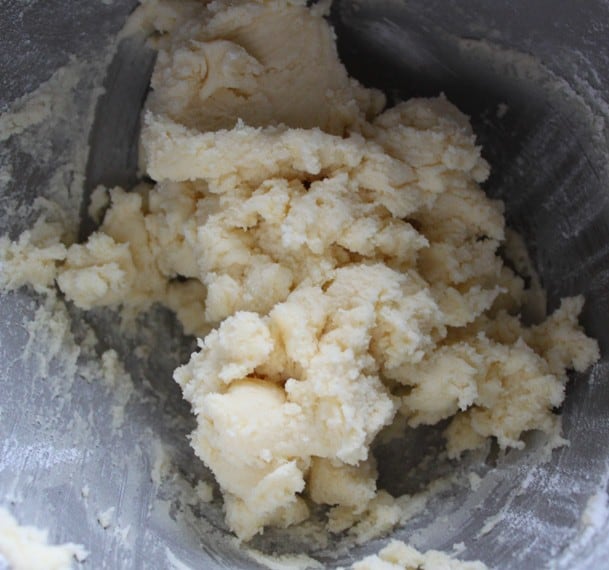
    Gluten-free Christmas cookie dough in a bowl.

    Add the dry ingredients.  After about 45 seconds, a firm dough forms. It’s almost time for cookies!

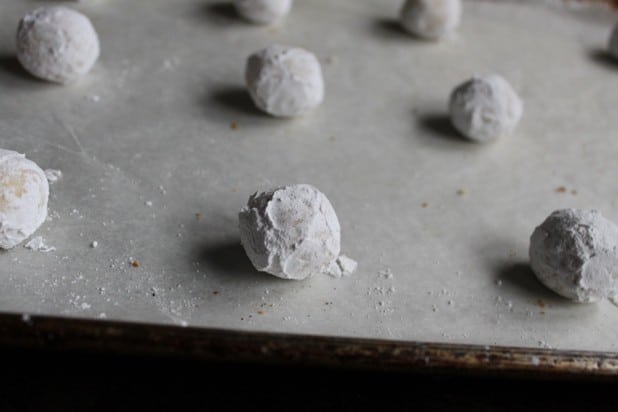
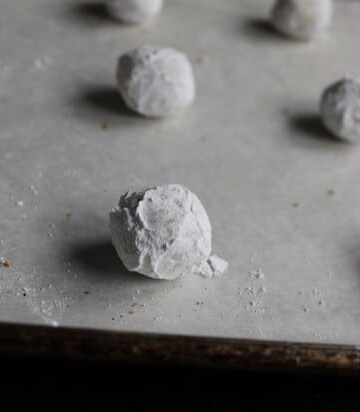
    Easy gluten-free Christmas cookie dough coated with powdered sugar on a baking sheet.

    After chilling the dough for ten minutes, roll them in powdered sugar. Bake in a preheated oven for about 12-15 minutes and you’ll have, you guessed it, COOKIES! (“COOKIES!” must be said in a cookie monster-like voice, of course!)

    Of course, if you don’t have the time to roll them in powdered sugar, skip this step. It add a pretty sugar glaze but isn’t essential.

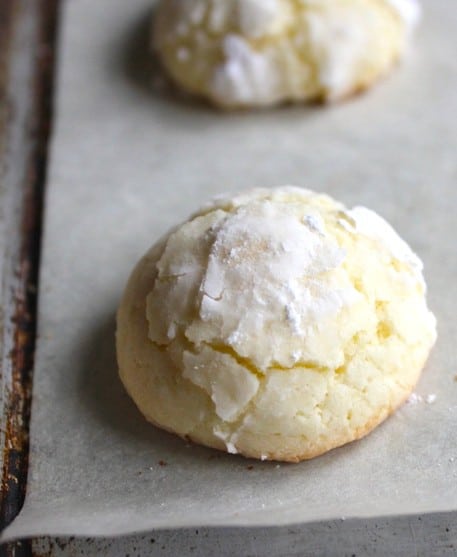
    Easy gluten-free Christmas cookie coated with powdered sugar on a baking sheet.


    COOKIES!

    Easy gluten-free Christmas cookie coated with powdered sugar on a baking sheet.
    5 from 3 votes
    Print

    How to Make the Easiest Ever Gluten-Free Christmas Cookies

    Easy-to-Make. Buttery Christmas cookies.

    Prep Time 10 minutes
    Cook Time 12 minutes
    Total Time 22 minutes
    Servings 15 cookies
    Author GlutenFreeBaking.com

    Ingredients

    • 1 1/4 cups gluten-free baking flour, Bob's 1:1 Gluten-Free Baking Flour recommended (see note below) (5 ounces; 142 grams)
    • 1/2 teaspoon baking powder
    • 1/2 teaspoon salt
    • 1/2 cup granulated sugar (3 1/2 ounces; 100 grams)
    • 6 tablespoons butter, softened (3 ounces; 85 grams)
    • 1 large egg (1 3/4 ounces; 50 grams)
    • 1/2 teaspoon vanilla extract
    • 1 cup powdered sugar (4 ounces; 112 grams)

    Instructions

    1. Preheat oven to 350 degrees F. Line a baking sheet with parchment paper and set aside.

    2. Whisk together gluten-free flour, baking powder, and salt in a small bowl. 

    3. In bowl of stand mixer, cream together butter and granulated sugar until well combined, about 45 seconds.
    4. Add egg. Cream until thoroughly incorporated. Be sure to stop mixer and scrape down sides and bottom of bowl at least once.
    5. Stop mixer. Add whisked dry ingredients. Turn mixer to medium-low. Mix until a dough forms.
    6. Chill dough for ten minutes.
    7. Scoop dough, about two teaspoons each, and toll into balls. Roll dough balls into powdered sugar. Place cookies, about two inches apart, on prepared baking pan.
    8. Bake cookies for 12-15 minutes or until cookies are firm and edges are golden brown. Transfer cookies to a wire rack*. Repeat with remaining dough.

    9. *If sugar melts during baking, roll warm cookies in powdered sugar.

    10. Store cookies in an airtight container for up to five days.

    Recipe Notes

    Ingredient Note:

    The original version of this recipe used individual gluten-free flours. It has since been updated and tested to use a gluten-free flour blend. If you enjoyed the original recipe, here are the flours:

    3/4 cup white rice flour (3 ounces; 85 grams)

    1/4 cup sweet rice flour (1 ounce; 28 grams)

    1/4 cup potato starch (1 ounce; 28 grams)


    How to Make Chewy Gluten-Free Soft Pretzels

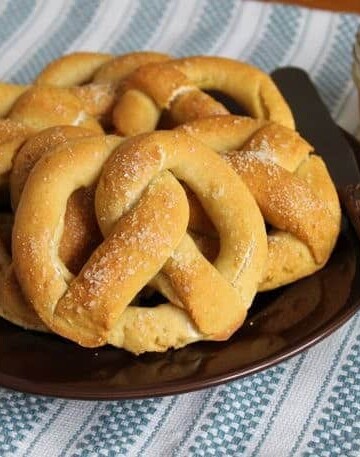
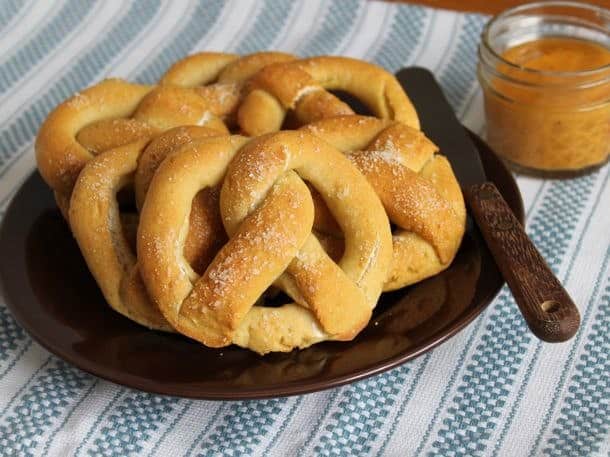
    Gluten-free pretzels on a plate with a jar of mustard sitting to the right.

    Gluten-free pretzels on a plate with a jar of mustard sitting to the right.

    Soft pretzels are just about perfect. They’re chewy, salty and great with everything from a beer to a salad. The thing is: they’re chewy. And gluten-free flour doesn’t do chewy well.

    But this year I decided I didn’t want to go through another football season or Oktoberfest without a soft pretzel.  So I headed into the kitchen.

    Since gluten, the protein found in wheat and other grains, is responsible for the distinctive soft pretzel chew, I began by focusing on the flour blend. The flavor of pretzels is rather subtle I first used white rice flour and tapioca starch.  I hoped the white rice flour would be bland enough to fade into the background while the tapioca starch, along with a little xanthan gum, provided chew. It worked. Sort of.

    The white rice flour was so bland that the pretzels tasted flat, and since I only used a little tapioca starch, there was very little chew.  One of my first tasters said, “These taste like they want to be soft pretzels but just aren’t. They’re odd.”

    Since I didn’t want bland pretzels, I replaced the white rice flour with brown rice flour. While the flavor was better, the pretzels were unappetizingly grainy.  Combining the white rice flour and brown rice flour solved this problem.

    During testing, I increased the amount of tapioca starch in the recipe.  From previous experience, I knew that too much tapioca starch could make a recipe gummy. I added it cautiously, and one day, after using 3/4 cup of tapioca starch, I pulled a baked pretzel apart. There was some resistance as I tore the pretzel and the crumb had the tight appearance of wheat-based soft pretzels.  When I took I bite, the pretzel felt chewy! Finally, a gluten-free soft pretzel that was chewy and flavorful.

    But texture isn’t the only characteristic unique to soft pretzels. They need to be dark brown and shiny. Commercial bakers achieve this by boiling the pretzels in water with a little food-grade lye, a powerful alkaline.  The solution turns the dough slightly yellow during boiling and aides the Milliard reaction during baking ,causing the pretzels to darken.

    Since I didn’t have any lye on hand, (and I’m guessing you don’t either!) I used an alkaline that I did have in the kitchen: baking soda. While baking soda isn’t nearly as powerful an alkaline as lye, it did turn the dough slightly yellow during boiling. The finished pretzels, however, were a little too light for my liking.

    Adding additional baking soda wasn’t solving the problem. On a whim, I added some granulated sugar to the solution. I hoped the sugar would help turn the pretzel a nice golden brown.

    It worked! And best of all, the additional sugar didn’t add sweetness to the pretzels, just a lovely golden brown color.

    Now, with a pretzel in hand, I’m ready for football season!

    Here’s how to make ’em!


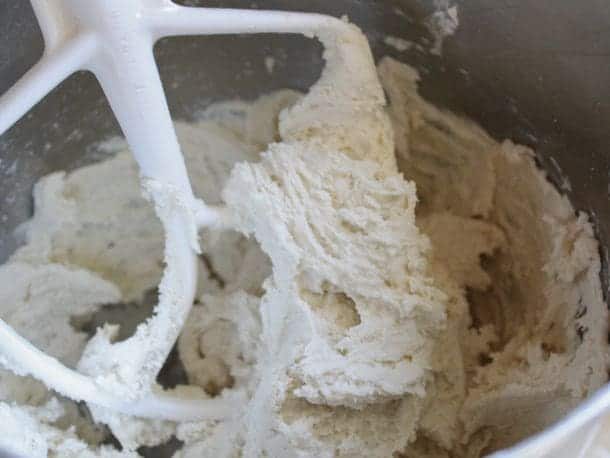
    Gluten-Free Soft Pretzel dough being mixed in a stand mixer.

    You want the dough stiff but not dry. Don’t worry if it doesn’t form a dough ball in the stand mixer. It won’t.

    After two minutes of mixing, no dry ingredients should cling to the bottom or sides of the mixing bowl. If dry ingredients remain, add one to two tablespoons additional water.

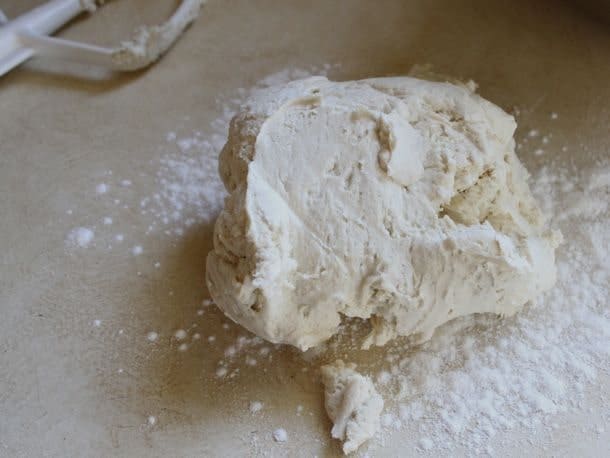
    Gluten-Free Soft Pretzel dough on a flour covered counter.

    Turn dough out onto a lightly white rice floured surface. Don’t use too much flour. A light dusting to prevent the dough from sticking to the counter is all you need.


    Gluten-Free Soft Pretzel dough on a white rice flour coated counter.

    Gently knead dough into a ball. Gluten-free dough requires a light touch. Once the dough forms a ball, stop kneading and place into a lightly oiled bowl to rise. Brush or spray the top of the dough with oil to prevent a skin from forming.

    Gluten-Free Soft Pretzel dough risen in a white bowl.

    Allow dough to rise until doubled in size. This usually takes about an hour but the time varies depending on temperature.

    Gluten-Free Soft Pretzel dough on a counter.

    Turn dough onto a very lightly white rice floured counter. Too much flour on the counter makes it hard to shape the pretzels. A light dusting of white rice flour will do.


    Gluten-Free Soft Pretzel dough cut into 12 pieces.


    Divide dough into equal portions. (A bench scraper works well for cutting the dough.)


    Gluten-Free Soft Pretzel dough rolled into a log.

    Knead each dough ball until it becomes smooth. It should lose its shaggy appearance.

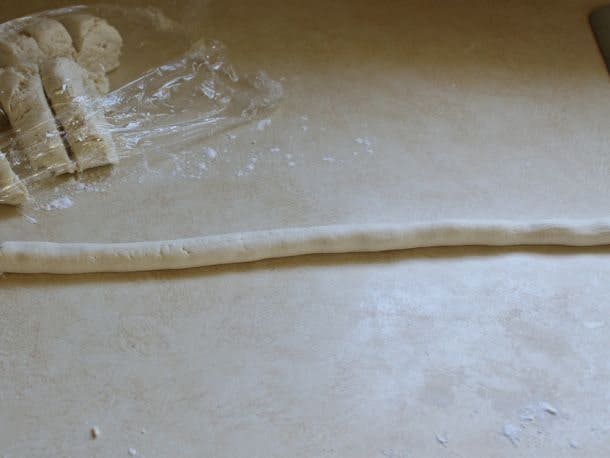
    Roll out into 12-inch log. Take care not to use too much flour on the countertop. If the dough has too much flour on the surface, brush it off with a pastry brush. Cover the other pieces of dough with a piece of plastic wrap.

    Gluten-Free Soft Pretzel dough rolled into a log and shaped into a "u" shape.

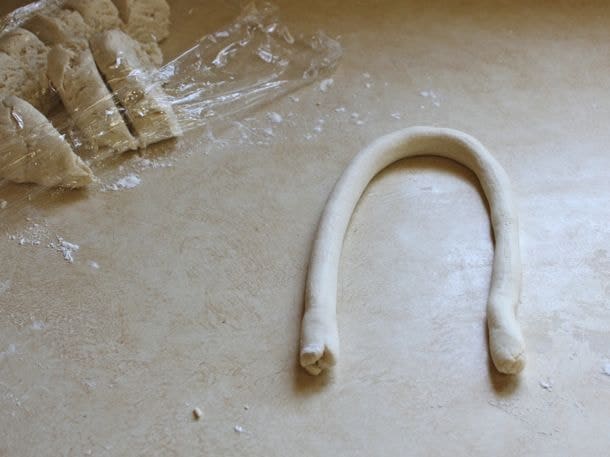
    Gently turn dough into an upside down “U.”

    Gluten-Free Soft Pretzel dough being shaped into a pretzel.

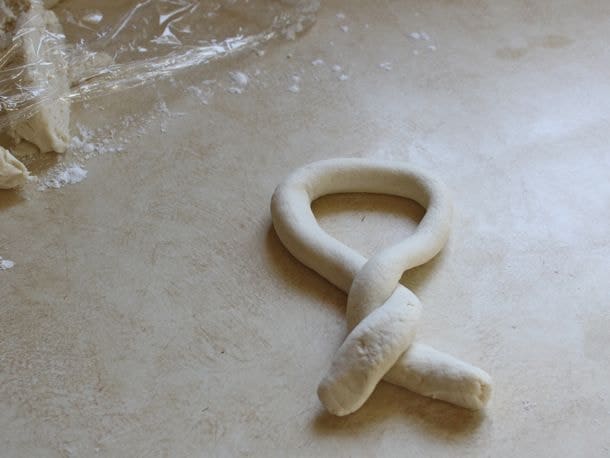
    Twist ends together.

    Gluten-Free Soft Pretzel dough shaped into a pretzel.

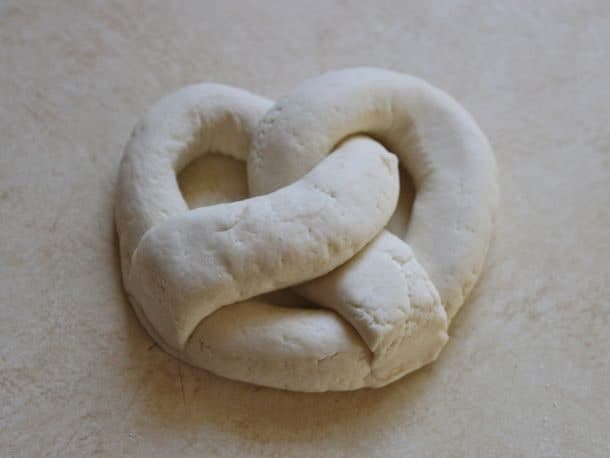
    Press the ends into the bottom of the “U”. You want to be sure the dough sticks to itself, so it doesn’t come apart while boiling.


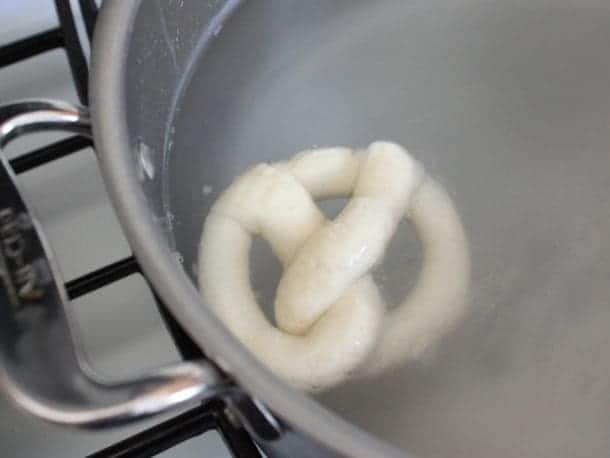
    Gluten-Free Soft Pretzel floating in simmering water.

    Boil the pretzels until they float.

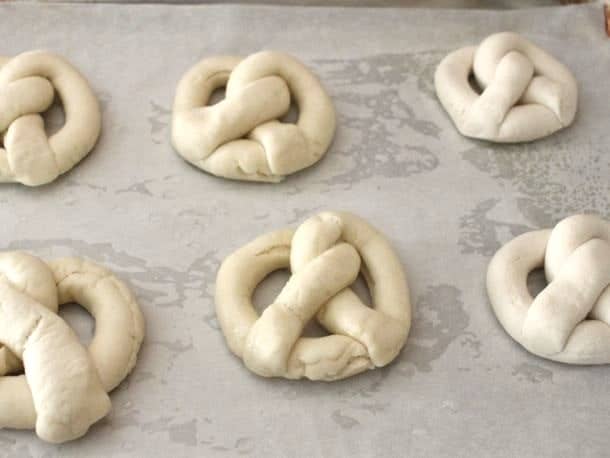
    Gluten-Free Soft Pretzel dough shaped on a baking sheet.

    Once boiled, the pretzels turn slightly yellow. (The four pretzels on the left have been boiled. The two pretzels on the right have not been boiled.) Sprinkle some kosher salt on the pretzels and bake.

    Gluten-free pretzels on a plate with a jar of mustard sitting to the right.

    Enjoy!

    Gluten-free pretzels on a plate with a jar of mustard sitting to the right.
    5 from 2 votes
    Print

    How to Make Chewy Gluten-Free Pretzels

    Prep Time 1 hour 30 minutes
    Cook Time 25 minutes
    Total Time 1 hour 55 minutes
    Servings 12 pretzels
    Author GlutenFreeBaking.com

    Ingredients

    For the Pretzels

    • 2 cups finely ground white rice flour (8 ounces; 226 grams)
    • 1 cup brown rice flour (5 ounces; 142 grams)
    • 3/4 cup tapioca starch (3 ounces; 85 grams)
    • 1 teaspoon salt
    • 1 teaspoon xanthan gum
    • 1/2 teaspoon baking powder
    • 1 cup warm water plus 2 tablespoons (9 ounces; 255 grams)
    • 1 packet active dry yeast (2 1/4 teaspoons)
    • 1 large egg (1 3/4 ounces; 50 grams)
    • 3 tablespoons light corn syrup (2 ounces; 56 grams)
    • 2 tablespoons vegetable oil (3/4 ounce; 21 grams)

    For the Water Bath

    • 16 cups water (128 ounces; 3.6 kilos)
    • 1/4 cup baking soda
    • 2 tablespoons granulated sugar (1 ounce; 28 grams)

    For the Topping

    • Kosher Salt

    Instructions

    1. For the Pretzels: In the bowl of stand mixer, combine white rice flour, brown rice flour, tapioca starch, salt, xanthan gum, and baking powder. Whisk to combine.

    2. In a small bowl, combine 1 cup warm water and active dry yeast. Stir with a fork. Allow to stand for three minutes. Add water-yeast mixture, egg, light corn syrup, and vegetable oil to dry ingredients.
    3. Fit stand mixer with paddle attachment. Mix on medium speed until dough forms, about 4 minutes. The dough should be firm but not dry. If any dry ingredients remain at the bottom of the bowl or if the dough seems dry, add the additional 2 tablespoons water.
    4. Turn dough out onto lightly white rice-floured counter. Dust your hands with white rice flour and knead dough into a ball until smooth. Take care not to use too much pressure while kneading.
    5. Transfer dough to lightly greased bowl. Lightly brush the dough with oil. Cover the bowl with plastic wrap and allow to rise until almost doubled in size, about 1 to 1 1/2 hours.
    6. Adjust oven racks to middle position and preheat oven to 425°F. Bring 4 quarts of water to a rolling boiling. Turn dough out onto a very lightly white rice floured countertop. Punch down dough gently to deflate. Cut into 12 pieces. Cover dough with plastic wrap. One at a time, knead each piece of dough until smooth. Then, roll out the dough pieces into 12 to14-inch logs. (You want little to no white rice flour on the area of the counter where you are rolling the dough. If there is too much flour on the outside of the dough, the pretzel dough won't stick to itself when you go to shape it.)
    7. Line two rimmed baking sheets with parchment paper. Working one log at a time, form the dough into a into "u". Twist each end together and then press the rope into the bottom of the "u". You want to press the dough firmly to ensure the ends stick to the "u" or the pretzel can unravel during boiling. Place shaped pretzels on prepared baking sheet.
    8. Prepare the Water Bath: Add the baking soda and granulated sugar to the boiling water. One at a time, boil the pretzels. If the pretzel floats, boil for about five seconds. If the pretzel sinks, wait for it to float to the top of the water and then remove. Return boiled pretzels to the prepared baking sheets. Sprinkle generously with kosher or pretzel salt.

    9. Bake until golden brown, about 25 minutes, rotating baking sheets halfway during baking. Remove and allow pretzels to cool. Pretzels are best served the day they're made. If desired, freeze once cooled and reheat in a warm oven.


    Fluffy Lemonade Pie

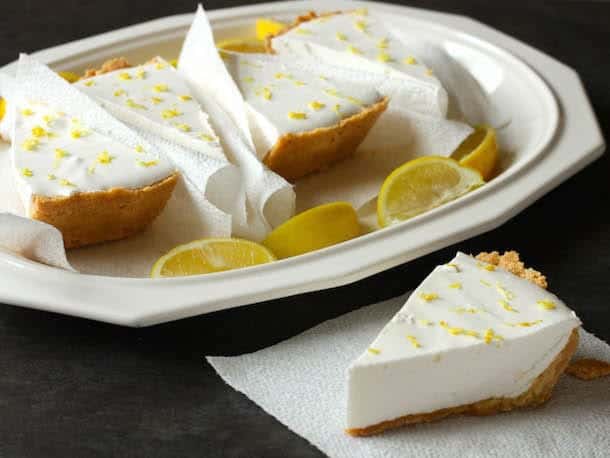
    Gluten-free lemonade pie.


    Fluffy Lemonade Pie Gluten Free

    Recently, a friend threw a casual summer potluck barbecue. The theme was “summer foods you loved as a kid.” I immediately thought of fluff pie, a Jell-O®-based dessert that always made an appearance at picnics when I was a kid. In fact, I think of it as a summer pie—even though there’s really nothing seasonal about it.

    If you aren’t familiar with this pie, it’s one of those classic back-of-the-box recipes. You whip soft-set lemon Jell-O® with whipped topping and spoon it into a crumb crust. That’s it. The filling is basically an impossible-to-mess-up Bavarian cream.

    As I went to make the pie, I remembered that my friend’s son can’t eat yellow food color. It makes him break out in hives. For a moment, I thought about making crispy treats for the barbecue but there was just something about that pie. So I decided to make it without the lemon Jell-O®.

    The first thing I did was check to make sure that freshly squeezed lemon juice wouldn’t inhibit the gelatin from setting. The usual offenders, like pineapple and papaya, were on the list but, thankfully, lemon juice seemed ok. I bloomed powdered gelatin in freshly squeezed lemon juice, whisked in a water-sugar mixture and let it set up for about two hours. Then I whisked the soft gelatin into some sweetened whipped cream, spooned it into a pie shell and hoped it would set. I was a little unsure how much gelatin I’d need to set a filling that was firm enough to slice. The process took a little extra time but, honestly, most of it was inactive.

     The filing set up firm enough to serve the pie sliced and placed on paper towels. Yup, it’s one of those pies that doesn’t require a fork—unless you want one. Without the food color from the Jell-O®, the filling came out almost white. A quick sprinkle of lemon zest added just the right amount of color and another whisper of lemon flavor. And although the color turned out pale, the flavor was a far cry from anemic. The fresh lemon juice combined with the sweetened whipped cream to create a lemonade-like flavor; at the party, it was the first dessert to go. Since there are still plenty of summer barbecues left, I’m already wondering, what flavor of fluff pie do I want to make next? Hmm…
    Gluten-free lemonade pie.
    Print

    Fluffy Lemonade Pie

    Prep Time 35 minutes
    Cook Time 8 hours
    Total Time 8 hours 35 minutes
    Author GlutenFreeBaking.com

    Ingredients

    For the Crust

    • 1 1/2 cups finely ground gluten-free vanilla cookies about 22 cookies or 1 (10.5-ounce) package, such as Schar brand
    • 4 tablespoons unsalted butter, melted (2 ounces; 56 grams)

    For the Filling

    • 1/4 cup fresh lemon juice from 2 lemons (2 ounces; 56 grams)
    • 2 tablespoons cold water (1 ounce; 28 grams)
    • 1 tablespoon unflavored gelatin
    • 3/4 cup cold water (6 ounces; 170 grams)
    • 1/2 cup granulated sugar (3 1/2 ounces; 100 grams)
    • 1 1/2 cups cold heavy cream (12 ounces; 340 grams)
    • 1/4 cup powdered sugar (2 ounces; 56 grams)
    • Zest of 1 lemon

    Instructions

    1. For the Crust: Preheat oven to 350°F. In small bowl, combine vanilla cookie crumbs and melted butter. Stir with a fork to combine. Mixture should be damp and hold together when pressed. Press crumb mixture onto the bottom and sides of a 9-inch pie plate. Bake until set and aromatic, about 10 to 12 minutes. Remove crust from oven and place on a wire rack to cool.
    2. For the Filling: Combine lemon juice and 2 tablespoons water in a small saucepan. Sprinkle gelatin on top and allow to stand for 5 minutes.
    3. In a separate small saucepan, combine 3/4 cup water and granulated sugar. Heat over medium-high heat, stirring occasionally, until sugar dissolves. Set aside.
    4. Cook gelatin mixture over low heat, without allowing liquid to boil, until gelatin is dissolved, about 4 minutes. In a small bowl, stir together gelatin mixture and sugar mixture. Chill until soft set, about 2 1/2 hours (the gelatin should wiggle but you don’t want it totally set).
    5. In the bowl of a stand mixer fitted with the whisk attachment, combine heavy cream and powdered sugar and whip to medium-firm stiffness. Add gelatin and whip until the gelatin is combined. Spoon into prepared pie crust. Sprinkle lemon zest over the top of the pie. Chill for 6 hours or until fully set. Serve. Leftover pie can be refrigerated for up to 4 days.


    Chewy Gluten-Free Granola Bars

    Copycat Recipe: Quaker's Chewy Granola Bars.

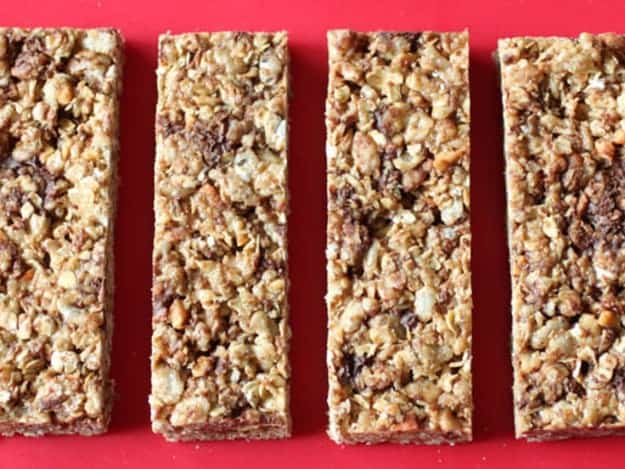
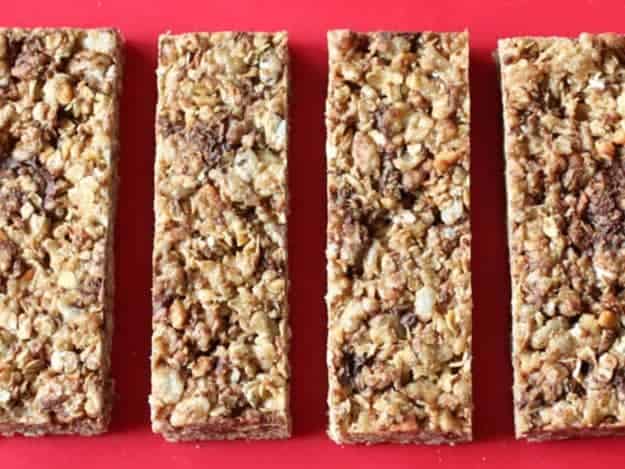
    Chewy gluten-free granola bars are loaded with chocolate chips and almonds.

    Chewy granola bars on red cutting board.


    You know those crazy dietary promises you make to yourself as a kid? Like, “When I grow up, I’ll eat frosting straight from the can whenever I want!” And then you grow up and forget all about them. Well, I once made such a promise to myself about Quaker’s Chewy Granola Bars…and I didn’t forget.

    The reason for the promise? My mom used to buy the bars, believing they were healthy (ha!). Then one day she ate one. “This is a candy bar!” she said after one bite. Duh—why did she think I loved them? From that moment on, the days of Chewy bars as a snack were over. I promised myself that when I grew up, I’d buy them whenever I felt like it.

    And you know what? I held true to it. Or I did, until I started my gluten-free diet and Quaker’s Chewy Granola Bars were, once again, out. I tried making gluten-free versions, and while the base of oatmeal and crispy rice wasn’t difficult, the texture tripped me up. I wanted the bars to be, well, chewy. I tried honey. I tried a homemade sugar syrup. I even tried baking the bars. But the bars either fell apart, were too hard, or were just plain off.

    Until now.

    I have finally nailed a copycat version of Chewy bars. The secret to that elusive chew? Marshmallows.

    But marshmallows alone don’t achieve the right flavor. A quick scan of the ingredients on the Quaker box reveals that there’s brown sugar in the originals. So I balanced the marshmallow with some brown sugar, and now they’re perfect.

    Plus, these bars are ridiculously easy to make. If you’ve ever made a batch of crispy bars, you already know everything you need to about making this recipe. You simply melt some butter (or coconut oil, if you don’t eat dairy) with brown sugar. Then melt in the marshmallows and stir in some gluten-free oats, crispy rice cereal, and—if you’re feeling crazy—nuts and chocolate chips. That’s it! You can make a batch of these in less than 15 minutes (not including the somewhat painful 2 hours of waiting for them to set in the refrigerator).

    If you’re wondering if these bars are too sweet with the marshmallows and brown sugar, just remember what my mother said: They’re basically candy bars. And they’re wonderful.

    Chewy granola bars on red cutting board.
    Print

    Copycat Recipe: Quaker Chewy Granola Bars

    A copycat gluten-free recipe for Quaker's Chewy Granola Bars
    Prep Time 15 minutes
    Cook Time 10 minutes
    Total Time 25 minutes
    Servings 24 bars
    Author GlutenFreeBaking.com

    Ingredients

    • Nonstick cooking spray
    • 2 cups gluten-free quick-rolled oats (6 1/4 ounces; 178 grams)
    • 2 cups gluten-free crisp rice cereal (about 2 ounces; 56 grams)
    • 1/4 cup chopped almonds (about 1 ounce; 28 grams)
    • 1/4 cup chocolate chips (1 1/2 ounces; 42 grams)
    • 1/2 teaspoon kosher salt
    • 6 tablespoons unsalted butter or coconut oil (3 ounces; 85 grams)
    • 1/3 cup dark brown sugar (2 1/2 ounces; 70 grams)
    • 3 cups marshmallows (about 5 ounces; 142 grams)

    Instructions

    1. Spray 9- by 13-inch baking dish with cooking spray. Set aside. In large bowl, toss together oats, crispy rice cereal, almonds, chocolate chips, and salt.
    2. In large saucepan, melt butter over medium-low heat. Add brown sugar and cook, stirring constantly, until sugar melts. Add marshmallows and continue to cook, stirring, until marshmallows melt. Turn off heat and stir in oat mixture until just combined.
    3. Press mixture evenly into prepared baking dish and refrigerate for 2 hours. Remove from refrigerator. Using thin metal spatula, lift granola out in a single layer. Cut into 24 bars. Store in an airtight container for up to two weeks.


    Crispy Gluten-Free Chocolate Chip Cookies

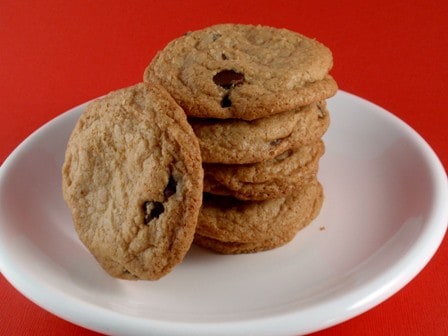
    Crispy Gluten-Free Chocolate Chip Cookies.

    Crispy Gluten-Free Chocolate Chip Cookies.

    One of my readers sent me a chocolate chip cookie recipe to convert. After taking one look at the recipe, I realized it was the famous “Perfect Chocolate Chip Cookie” recipe from Cook’s Illustrated magazine. However, Carol’s recipe was the original version. They’ve since updated it to use browned butter and her’s didn’t include it.

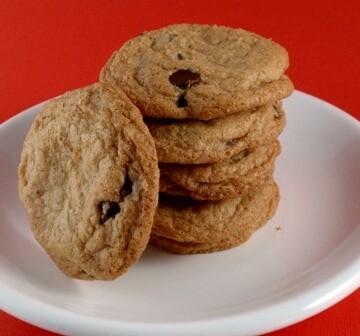
    When made with wheat flour, this recipe makes chewy chocolate chip cookies. After converting the recipe, my cookies were not chewy or soft or tender. They were undoubtedly crispy. I was bummed. Then a funny thing happened. I brought a plate of them to my mom’s workplace and people gobbled them up. “But they are all wrong,” I kept thinking. Only they weren’t. They might not have the chewy texture I was looking for but, as is, they are delicious. And I couldn’t keep a delicious chocolate chip cookie recipe to myself, could I?

    Since the recipe uses melted butter, I don’t use an electric mixer to make the dough. I stir it together with a wooden spoon. If you’d prefer an electric mixer, go ahead and use one!

    I’m still working on a chewy chocolate chip recipe for Carol. Until then, enjoy these crispy chocolate chip cookies!

    Crispy Gluten-Free Chocolate Chip Cookies.
    5 from 1 vote
    Print

    Crispy Gluten-Free Chocolate Chip Cookies

    Prep Time 20 minutes
    Cook Time 16 minutes
    Total Time 36 minutes
    Servings 3 dozen
    Author GlutenFreeBaking.com

    Ingredients

    • 1 1/4 cups white rice flour (5 ounces; 142 grams)
    • 1/2 cup sweet rice flour (2 ounces; 56 grams)
    • 1/2 cup cornstarch (2 ounces; 56 grams)
    • 1/2 teaspoon baking soda
    • 1/2 teaspoon salt
    • 1 1/2 sticks butter, melted (3/4 cup; 6 ounces; 170 grams)
    • 1 cup dark brown sugar, packed (7.5 ounces; 212 grams)
    • 1/2 cup granulated sugar (3 1/2 ounces; 100 grams)
    • 1 large egg (1 3/4 ounces; 50 grams)
    • 1 egg yolk (1/2 ounce; 14 grams)
    • 2 teaspoons vanilla extract
    • 1 (12 ounce) bag chocolate chips

    Instructions

    1. Preheat oven to 325 degrees F. Line a baking sheet with parchment paper. Set aside.
    2. Whisk together white rice flour, sweet rice flour, cornstarch, baking soda, and salt in a small bowl.

    3. Combine melted butter, sugars, egg, egg yolk and vanilla extract in a large bowl. Stir until smooth. Add the flour. Using a wooden spoon, stir together until a dough forms. Add chocolate chips and stir until just combined.

    4. Drop dough, about 2 teaspoons each, onto prepared cookie sheet.
    5. Bake for 15-18 minutes or until golden brown. Cool cookies on a wire rack. Store in an airtight container for up to five days. 


    How to Make Salt Potatoes

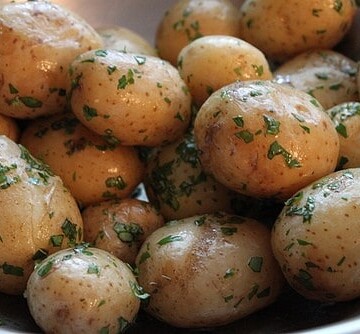
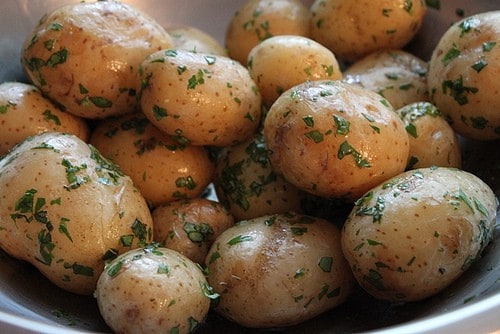
    Steamed potatoes coated in butter and herbs.

    Steamed potatoes coated in butter and herbs.

    Years ago, I read Kim Severson’s piece in the New York Times about salt potatoes. I remember thinking, “Those sound interesting. I should try them.” Two years later, I finally did! (I’m never one to rush!)

    To be honest, I was surprised to learn that salt potatoes are a central New York dish. I’d never heard of the practice of boiling “new” potatoes in copious amounts of salt. Somehow this dish didn’t make the 150 mile jump from Syracuse to Albany. I’m sorry it didn’t! These potatoes are fantastic!

    What makes these potatoes unique? The texture! The interior was really smooth and tender–almost like boiled potatoes, baked potatoes and mashed potatoes got together and created a baby! A tender, delicious, salty potato baby.

    If you’re worried, like I was, that these potatoes will taste too salty, fear not. The salt is just right. And they are nowhere as salty as potato chips. To finish, I tossed the potatoes in melted butter and herbs.

    Salt, potatoes, butter and herbs? Doesn’t that sound great?

    Here’s how to make ’em

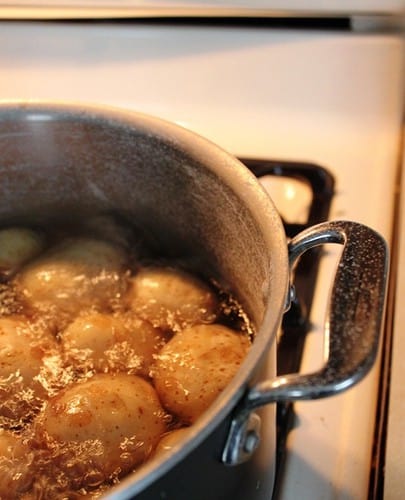
    Salt potatoes boiling in a large pot.

    Grab a large pot and bring 10 cups of water and 1 1/2 cups of Kosher salt to a boil. Then add the potatoes. There’s so much salt in the water that you’ll see it cling to the pot as the potatoes cook.

    Salt potatoes.

    Drain. A lovely white coating of salt will cling to the potatoes.

    Steamed potatoes coated in butter and herbs.

    Toss with butter and fresh herbs. Or just leave ’em alone. The salt potatoes are great on their own.

    Steamed potatoes coated in butter and herbs.
    Print

    New York Salt Potatoes

    adapted from a recipe in the New York Times, August 22, 2008
    Prep Time 5 minutes
    Cook Time 20 minutes
    Total Time 25 minutes
    Servings 4
    Author GlutenFreeBaking.com

    Ingredients

    • 10 cups of water
    • 1 1/2 cups of kosher salt Note from the NYT: Add another cup if using the Diamond Crystal brand
    • 3 pounds well-scrubbed small red or white potatoes I used new white potatoes
    • 1/2 stick melted butter
    • Chopped fresh herbs about a 1/4 cup (I used parsley and basil because it was what I had on-hand at the time.)

    Instructions

    1. Bring the water and salt to a boil. Once it reaches a boil, add the potatoes.
    2. Boil for 20 minutes or until for tender.
    3. Drain and toss with butter and herbs. (If you don't want to toss with butter and herbs, you will be able to see the light salt crust on the potatoes.)

    Gluten-Free Chocolate Peanut Butter Pinwheels

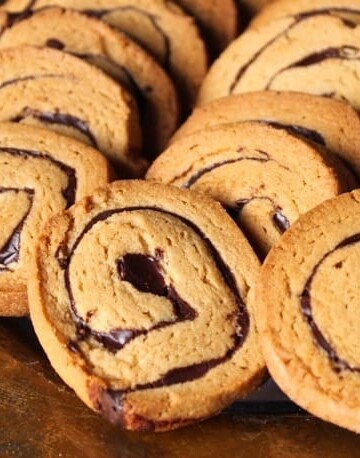
    Chocolate Peanut Butter Pinwheels.

    A holiday classic goes gluten-free! These chocolate peanut butter pinwheels look stunning and are always a welcome addition to any holiday cookie platter. The dough needs a night to chill. So be sure to make it the day before you plan to bake.

    Chocolate Peanut Butter Pinwheels.

    Peanut butter and chocolate go together like cookies and Santa Claus! This cookie recipe was requested by Tina. She sent along the recipe after we chatted about the holiday cookies on Facebook. I’m so glad we had that conversation! Because these cookies are seriously good.

    To make them, you  need two pieces of parchment and a bit of patience. You spread warm chocolate onto cookie dough and roll it up, as Tina says, “jelly roll-style”. The resulting cookies are so tender that they melt on your tongue, leaving behind the earthy flavor of peanut butter with a hint of chocolate from the swirl.

    Chocolate Peanut Butter Pinwheels.
    Print

    Chocolate Peanut Butter Pinwheel Cookies

    Be sure you have parchment paper on hand before making these cookies. You use it to roll the dough up into a pinwheel.
    Prep Time 30 minutes
    Cook Time 10 minutes
    Total Time 40 minutes
    Servings 36 cookies
    Author GlutenFreeBaking.com

    Ingredients

    • 1 1/2 cups white rice flour (6 ounces; 170 grams)
    • 1/2 cup sweet rice flour (2 ounces; 56 grams)
    • 1/2 cup cornstarch (2 ounces; 56 grams)
    • 1 teaspoon baking soda
    • 1/2 teaspoon salt
    • 1/4 teaspoon xanthan gum
    • 2 sticks unsalted butter, softened (1 cup; 8 ounces; 226 grams)
    • 1 cup firmly packed dark brown sugar (7 1/2 ounces; 212 grams)
    • 1 cup smooth peanut butter (9 1/2 ounces; 270 grams)
    • 1 large egg (about 1 3/4 ounces; 50 grams)
    • 1 teaspoon vanilla extract
    • 1 cup semisweet chocolate pieces or chocolate chips (6 ounces; 170 grams)
    • 1 teaspoon butter

    Instructions

    1. Make the Dough: Whisk together white rice flour, cornstarch, sweet rice flour, baking soda, salt, and xanthan gum in a small bowl. 

    2. In bowl of stand mixer fitted with paddle attachment, cream together butter and dark brown sugar until thick paste forms. Add peanut butter, cream until smooth. Stop mixer. Scrape down bottom and sides of the bowl. Add egg and vanilla extract, cream until smooth, about 30 seconds.
    3. Stop mixer. Add dry ingredients. Mix until dough forms. Generously white rice flour your countertop. Turn dough out onto counter and pat into a round. Use a knife and cut dough in half.
    4. Place one half of the dough on a piece of parchment paper. Roll into a rectangle, about 8x10-inches. Set aside. Repeat with remaining dough. (Each piece of dough should be on its own piece of parchment.
    5. Prepare the filling: Melt chocolate in microwave-safe bowl. Add butter and still until smooth. Allow to cool for two minutes. let cool completely. Spread each dough-rectangle with half of the chocolate mixture.
    6. Starting with the long edge, roll dough tightly, using parchment to aid the rolling, if needed, into a log. Gently press edge to seal. Roll parchment around log and then wrap with plastic wrap to seal.
    7. Refrigerate overnight.
    8. Preheat oven to 375°F. Line baking sheets with parchment paper.
    9. With sharp knife, cut 1/4-inch slices. Place slices 1 1/2 inches apart on baking sheet.

    10. Bake until golden brown, about 10 minutes. Allow cookies to cool on baking sheet for five minutes before transferring to a wire rack and cool.


    Easy Gluten-Free S’more Pie

    S'more Pie.

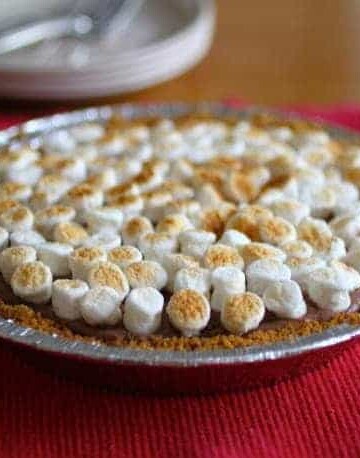
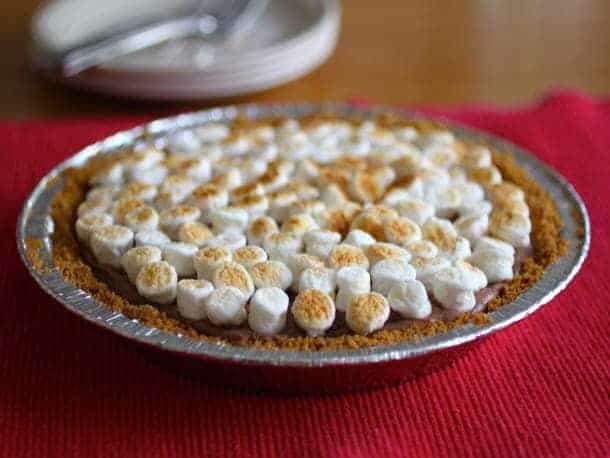
    This gluten-free s’more pie makes a fun and easy summer dessert. A simple gluten-free graham crust is filled with chocolate pudding and topped with marshmallows. You get all the yumminess of a s’more without the campfire!

    S'more Pie on a red tablecloth.

    One year I wanted a fun way to bring s’mores to a party. I doubted the hostess would be pleased if I showed up with a bag of marshmallows, graham crackers, and chocolate bars and asked if she would, kindly, set up a fire. So, I brought a s’more pie instead. My friends, a mix of folks who love to camp and those who don’t, all agreed that the pie reminded them the classic campfire treat.

    To make it, start with a gluten-free graham cracker crust. I used homemade gluten-free graham crackers. However, you don’t need to make homemade crackers only to grind them up. There’s lots of gluten-free graham cracker options available. You could use store bought gluten-free grahams or pick up a premade gluten-free crumb crust.

    Then fill the  crust with chocolate pudding (homemade or boxed) and top with marshmallows. Since s’mores require toasted marshmallows, you put the pie under the broiler to toast them. This step only takes a minute or two. Seriously. You don’t want to walk away while browning the marshmallows.

    Is this pie a replacement for classic s’mores? No! Of course not. But it’s fun—and tasty too. And, it doesn’t require a fire to make!

    S'more Pie.
    5 from 1 vote
    Print

    Gluten-Free S'more Pie

    You can use either homemade chocolate pudding or boxed chocolate pudding for this recipe.
    Prep Time 15 minutes
    Cook Time 12 minutes
    Total Time 27 minutes
    Servings 8
    Author GlutenFreeBaking.com

    Ingredients

    For the Crust

    • 1 1/3 cups gluten-free graham cracker crumbs (5 ounces; 142 grams)
    • 4 Tablespoons butter, melted (2 ounces; 56 grams)
    • 2 Tablespoons granulated sugar (about 1 ounce; 24 grams)

    For the Filling and Topping

    • 2 boxes chocolate pudding, prepared according to directions for pie filling Cook and Serve or Instant
    • 1 1/2 cups mini-marshmallows (about 2 1/4 ounces; 65 grams)

    Instructions

    1. Preheat oven to 350 degrees F.
    2. In a small bowl, combine the graham cracker crumbs, melted butter and sugar. Stir until the crumbs are damp and hold together. Transfer the crumbs to a 9-inch pie pan. Using the back of a spoon, press the crumbs into the bottom of the pan and up the sides.

    3. Bake for 10-12 minutes or until golden brown. Remove from the oven, place on a wire rack and allow to cool.
    4. Spoon the chilled pudding into the baked pie crust. Cover with mini-marshmallows.

    5. Preheat your broiler and toast the marshmallows under the broiler. Serve and enjoy. Store any leftover pie in the refrigerator.


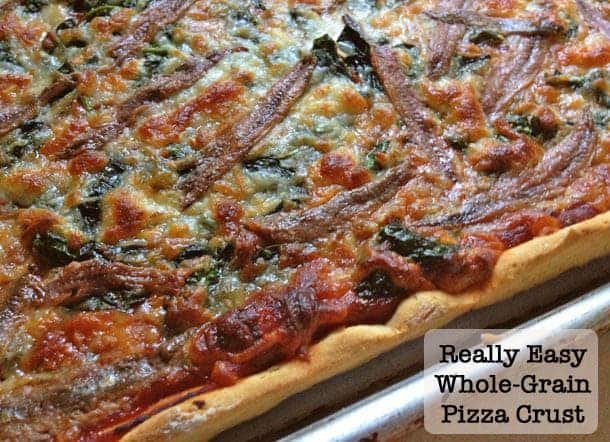
    Easy Whole-Grain Gluten-Free Pizza Crust

    Whole Grain Gluten-Free Pizza Crust.

    Whole Grain Gluten-Free Pizza Crust

    I love pizza! And I’m always tinkering with new recipes, using different flours, adding dried herbs to the crust, you know, playing.  But when I want to make a quick pizza, I grab a box of Chebe all-purpose bread mix. While I don’t like the tapioca-based mix “plain”, it’s great when you add some gluten-free flour to it. Lately, I add millet and sorghum. Thanks to the stretchy nature of modified tapioca starch, the recipe doesn’t require xanthan gum.

    All you need to do is open the bag, add the flours, eggs, water and oil and stir. That’s it! The dough relies on baking powder not yeast for its rise, so I mix it up while the oven preheats. No waiting needed!

    The one step that requires the most time is pressing the dough into the pan. The dough is sticky. So instead of rolling it out, I divide it into quarters and place one quarter into each corner of the pan. Then I press, press, press the dough into the pan. After a minute or so, the dough quarters come together and cover the entire pan.

    After pressing out the dough, bake it (untopped!) until golden brown. Then remove the pizza from the oven, top as you wish, and return to the oven. That’s it! Pizza in about an hour!

    Whole Grain Gluten-Free Pizza Crust.
    Print

    Easy Whole Grain Gluten-Free Pizza Crust

    The recipe uses millet flour and corn flour. Feel free to use whatever whole grain gluten-free flour you enjoy. Just don't skip the Chebe mix or the recipe won't work.
    Prep Time 20 minutes
    Cook Time 30 minutes
    Total Time 50 minutes
    Servings 1 large pizza
    Author GlutenFreeBaking.com

    Ingredients

    • 1 (7.5 ounce) package Chebe Bread All-Purpose Mix
    • 1/2 cup millet flour, plus extra for dusting (2 1/2 ounces; 128 grams)
    • 1/2 cup sorghum flour (2 1/2 ounces; 128 grams)
    • 2 teaspoons baking powder
    • 1 cup water (8 ounces; 226 grams)
    • 2 large eggs (about 3 1/2 ounces; 100 grams, out of shell)
    • 3 tablespoons olive oil (1 1/3 ounces; 37 grams)

    Instructions

    1. Preheat oven to 425°F. Spray a rimmed baking sheet with non-stick cooking spray. Set pan aside.
    2. In medium mixing bowl, whisk together Chebe mix, millet flour, sorghum flour, and baking powder. Add water, eggs, and olive oil. Stir together with a wooden spoon until a thick, sticky dough forms.
    3. Loosely divide dough into quarters. Generously flour each dough quarter with millet flour. Do the same with your hands. This dough is sticky. Be sure to use enough flour. This prevents it from sticking.
    4. Use your hands and press dough into the pan. The motion is something like "press and stretch." If your hands begin to stick to the dough, add more flour. Work the dough so all four quarters meet and cover the pan evenly.
    5. Bake until lightly golden brown, about twenty minutes.
    6. Remove pan from oven. Increase oven to 475°F. Top pizza as desired. Return to oven and bake until cheese bubbles and is golden brown.
     

    Gluten-Free Browned Butter Chocolate Chip Cookies

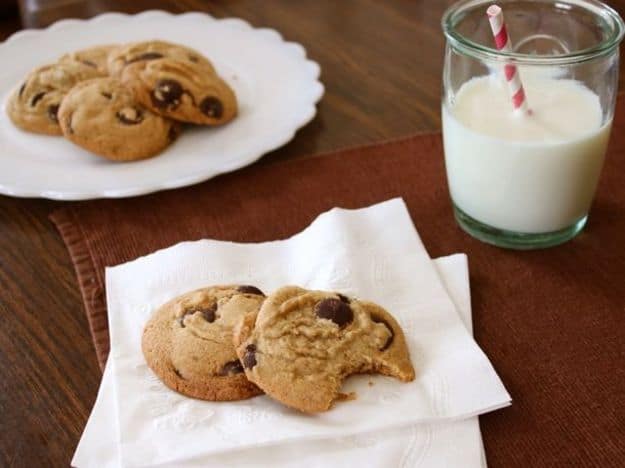
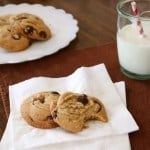
    Gluten-free brown butter chocolate chip cookies on a napkin. A glass of milk and a platter of cookies is in the background.

    The addition of brown butter and golden syrup makes these gluten-free chocolate chip cookies rich and chewy.

    Gluten-free brown butter chocolate chip cookies on a napkin. A glass of milk and a platter of cookies is in the background.

    The other day I tried to create chewy gluten-free chocolate chip cookies, and while this version missed the chewy mark, they was so flavorful that I didn’t mind. The flavor comes from golden syrup and browned butter, two ingredients you don’t usually find in chocolate chip cookies. They lend a nutty, caramel-like flavor to the already buttery cookies.

    While these aren’t super-chewy cookies, they are softer than traditional gluten-free chocolate chip cookies because of the golden syrup, egg yolks, and a low baking temperature. If you prefer soft and chewy cookies, under-bake the cookies slightly. To do this, reduce baking time until the cookies are just set and faintly brown on the edges.

    If you’re dairy-free or egg-free, this recipe can be adapted to fit your diet. For dairy-free cookies, replace the browned butter with melted shortening or vegetable oil. The finished cookies lack the caramelized flavor from the browned butter. To make up for this, add a splash (about two teaspoons) of vanilla. For egg-free cookies, replace the eggs with ground flaxseed.

    Gluten-free brown butter chocolate chip cookies on a napkin. A glass of milk and a platter of cookies is in the background.
    Print

    Gluten-Free Browned Butter Chocolate Chip Cookies

    Brown butter makes these gluten-free chocolate chip cookies rich and tender. 

    Prep Time 25 minutes
    Cook Time 13 minutes
    Total Time 38 minutes
    Servings 24 cookies
    Author GlutenFreeBaking.com

    Ingredients

    • 1 1/2 sticks unsalted butter (3/4 cup; 6 ounces; 170 grams)
    • 1 1/4 cups finely ground white rice flour (5 ounces; 142 grams)
    • 1/2 cup sweet rice flour (2 ounces; 56 grams)
    • 1/4 cup cornstarch (1 ounce; 28 grams)
    • 1/2 teaspoon baking soda
    • 1/2 teaspoon salt
    • 3/4 cup dark brown sugar, packed (5 1/4 ounces; 148 grams)
    • 1/4 cup golden syrup (2 3/4 ounces; 78 grams)
    • 2 large egg yolks (1 ounce; 28 grams)
    • 2 cups gluten-free chocolate chips (12 ounces; 340 grams)

    Instructions

    1. Adjust oven rack to center position and preheat oven to 325°F. Line rimmed baking sheet with parchment paper and set aside.
    2. In small pot over medium-low heat, melt butter. Stir occasionally. After foam subsides, watch butter until milk solids turn golden brown, about five minutes. Remove pot from heat and allow butter to cool. While butter cools, whisk together white rice flour, sweet rice flour, cornstarch, baking soda, and baking powder in medium bowl.
    3. In bowl of stand mixer fitted with paddle attachment, combine brown sugar, golden syrup, and cooled brown butter. Mix on medium speed to combine. Stop mixer. Add dry ingredients. Turn mixer on to medium. Blend until a thick dough forms. Dough will be dry. Add egg yolks. Blend until smooth dough forms. Stop mixer. Add chocolate chips. Turn mixer to low. Mix until chocolate chips are incorporated.
    4. Drop dough, about one tablespoon each, onto prepared baking sheet. Space dough about two inches apart. Bake until edges are just set and cookies are faintly golden brown, about 13 minutes. (For softer and chewier cookies, bake until cookies are just set.) Remove cookies and allow to cool on baking sheet for two minutes. Transfer cookies to wire rack to cool completely. Repeat with remaining dough.


    Gluten-Free Chiffon Cake

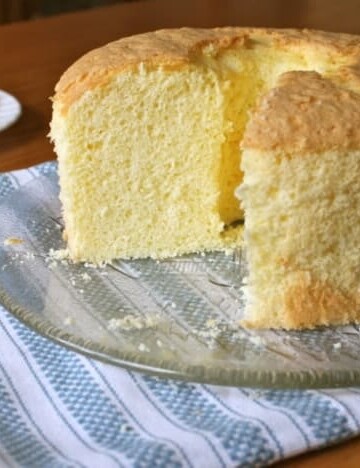
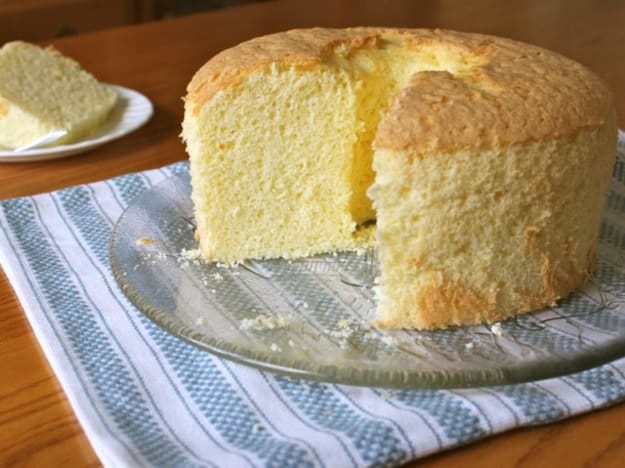
    Gluten-Free Chiffon Cake on a platter.

    This gluten-free chiffon cake is a showstopper. Light and airy, it’s angel food cake’s richer cousin.
    Gluten-Free Chiffon Cake on glass platter.

    For a cake with such whisper-soft texture, chiffon cake certainly made some noise when it entered the food scene. The recipe was created–and kept top secret for around two decades–by a salesman-turned-caterer named Harry Baker. Before Baker sold the recipe to General MIlls in 1948, he made chiffon cakes for the Hollywood Brown Derby and the light cake quickly gained a following.

    Capitalizing on its popularity, General Mills released the recipe along with the claim that it was, “The first new cake recipe in 100 years.” (Sounds like something Don Draper would write, doesn’t it?)

    Leavened mostly with whipped egg whites, chiffon cake bakes up light and airy, similar in texture to angel food cake. Unlike angel food cake, which only uses egg whites, chiffon cake uses the entire egg. The yolks are mixed into the batter before being folded into the whipped egg whites. They bring richness and a subtle yellow hue to the cake.

    The original recipe for this cake relied on pastry flour; this low gluten flour gave the cake a soft, tender crumb. So converting it to gluten-free was relatively easy because the cake never fully relied on gluten structure to give it structure. White rice flour, potato starch and tapioca starch replaced the pastry flour nicely; heavier flours, like brown rice flour and sorghum proved too heavy for the cake, leaving it with a dense crumb and unpleasant, gritty texture. Made with white rice flour, it baked into the lightest, softest cake I’ve ever had (!). In this case, the lack of gluten seems to have benefited the cake.

    To achieve that light, soft texture, it takes a bit of care to put the cake together. No one would call this a quick recipe! Keep these tips in mind when putting the cake together.

    How to Make Gluten-Free Chiffon Cake

    Degrease your mixing bowl and whip. Egg whites and fat are enemies. If any fat is present, the egg whites won’t whip to full volume. Before you crack your first egg, check your mixing bowl and whip. If any grease is present, get rid of it by washing the bowl with soap and water. (Some bakers swear by using lemon juice or white vinegar to wash the bowl.)

    Start with cold eggs. While egg whites are best whipped at room temperature, they’re harder to separate when warm. To get around this, separate the eggs when they’re cold and then allow them to come to room temperature before whipping.

    Keep egg yolks out the egg whites. Be sure no egg yolk finds its way into the bowl of whites. It’s a good idea to separate your egg over two bowls, a small one for the whites, and a large one for the yolks. After separating the egg, inspect the white. If no yolk is present, transfer the white to a large grease-free mixing bowl. This way, you’re sure that each egg white that goes into the bowl is yolk free.

    Use a large bowl for the batter. You’ll be folding the whipped egg whites into the cake batter. Therefore, it’s essential to select a bowl that can hold a lot of batter. I used my 5 quart bowl for the recipe.

    Add the whipped egg whites in stages. For the first addition, you want to lighten the batter by gently folding in about a quarter of the whipped egg whites. After that, fold in each addition of egg white until no lumps remain. (More about lumps in a second.)

    Keep the spatula under the batter. Here’s a little egg white folding trick: As you fold the egg whites into the batter, keep your spatula submerged in the batter at all times. Don’t lift it out of the batter after each “fold” Rather, slide the spatula into the center of the bowl, then “fold” the batter by pulling the spatula toward the edge of bowl, lifting batter over the egg whites. Then bring the spatula back toward the center of the bowl to incorporate the whites into the batter. As you fold, it helps to slowly spin the bowl.

    Check for lumps in the batter. Before you stop folding the egg whites into the batter, check for unincorporated egg whites. None should remain. If they do, the finished cake will bake unevenly with large air holes throughout. If you see any lumps of egg whites, fold a little longer. Don’t “whack” the spatula on the side of the bowl. It’s tempting to clear the egg whites that cling to the spatula by whacking the spatula on the side of the bowl. This deflates the batter. Same thing goes for when you add the batter to the pan. Don’t whack the spatula on the side of the cake pan to get rid of excess batter.

     Don’t grease the pan. During baking, the batter clings to the side of the ungreased pan, helping the cake stay nice and high. This is one time where a cake sticking to a pan is a good thing!

    Cool the cake upside down. Even after baking, chiffon cakes require a little extra TLC. To prevent the cake from collapsing, cool it upside down. Today, many tube pans include little legs that you can invert the pan onto. However, if your pan doesn’t have legs or if your cake rises higher than the legs, carefully slide the center of the cake pan onto a glass bottle–like a wine bottle or gluten-free beer bottle.

    And while this cake requires almost-scientific precision, it still welcomes creativity. As written, the recipe makes a vanilla-scented chiffon cake. But flavor it as you wish–orange and lemon are always popular variations.

    *Low-gluten pastry flour contains gluten and is not suitable for those on a gluten-free diet.

    Gluten-Free Chiffon Cake on a platter.
    4.82 from 11 votes
    Print

    Gluten-Free Chiffon Cake

    Light and airy gluten-free chiffon cake. 

    Prep Time 30 minutes
    Cook Time 1 hour
    Total Time 1 hour 30 minutes
    Author GlutenFreeBaking.com

    Ingredients

    • 1 1/2 cups granulated sugar (10 1/4 ounces; 290 grams_
    • 1 1/4 cups finely ground white rice flour (5 ounces; 142 grams)
    • 1/2 cup potato starch (2 ounces; 56 grams)
    • 1/4 cup tapioca starch (1 ounce; 28 grams)
    • 1 tablespoon baking powder
    • 1 teaspoon salt
    • 1/2 teaspoon xanthan gum
    • 7 large eggs, separated (For the whites, about 8 3/4 ounces; 248 grams. For the yolks: 3 1/2 ounces; 100 grams)
    • 3/4 cup water (6 ounces; 170 grams)
    • 1/2 cup vegetable oil (3 1/2 ounces; 100 grams)
    • 2 teaspoons vanilla extract
    • 1/4 teaspoon cream of tartar

    Instructions

    1. Adjust oven rack to middle position and preheat oven to 325°F. Whisk together granulated sugar, white rice flour, potato starch, tapioca starch, baking powder, salt, and xanthan gum in medium bowl. Set aside. In large mixing bowl, whisk together egg yolks, water, vegetable oil, and vanilla extract. Add whisked dry ingredients. Mix until thick batter is thick and smooth.
    2. In bowl of stand mixer fitted with whisk attachment, combine egg whites and cream of tartar. Whip on high speed until medium peaks form. Add whipped egg whites, one quarter at a time, to batter. Fold, taking care not to deflate the batter, until no large lumps of egg whites remain.
    3. Spoon batter into ungreased 10-inch tube (angel food) pan. Bake until cake is golden brown and springs back to the touch, about one hour. Remove from oven and immediately invert pan either onto legs that are on the pan or onto the neck of a beer or wine bottle. Allow cake to cool in the pan upside down.
    4. To remove cake from pan, run a knife around the outside of the cake and around the tube. Turn cake onto a serving plate. Store cake, covered, on the counter for up to four days.


    Crunchy Gluten-Free Granola

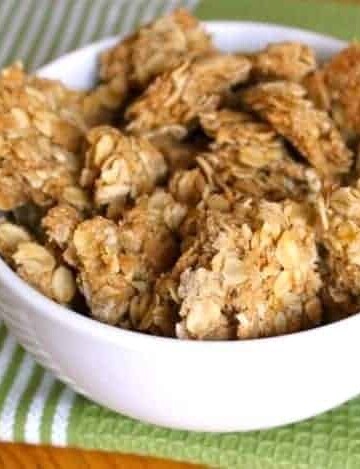
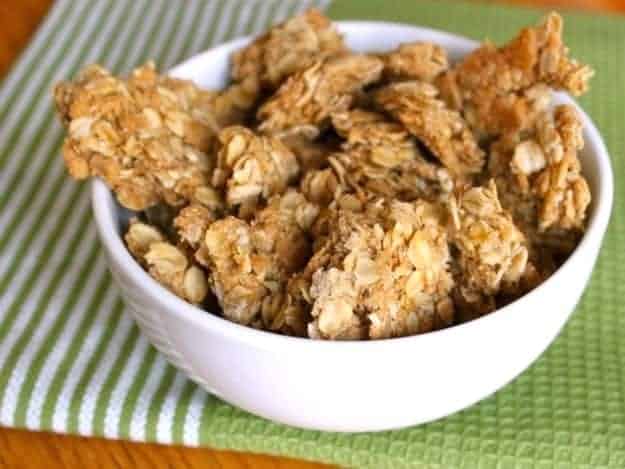
    Crunchy gluten-free granola clusters in a bowl.

    Crunchy gluten-free granola clusters are so fun to make–and fun to eat! Made with almond flour, instead of chopped almonds, there’s great flavor in every bite.

    Crunchy gluten-free granola clusters in a bowl.

    Kitchen flops are usually only good for one thing: stories. “Hey, remember the time I forgot to put sugar in that cake and served it to your mother? Was that a nightmare or what?”

    When I set out to create a gluten-free version of crunchy granola bars, à la Nature Valley’s, it never occurred to me that I might have a potential flop on my hands. I mean, it’s granola. You toss some oats, sugar, and nuts into a bowl and bake. What could go wrong?

    Turns out that baking isn’t the problem with crunchy granola bars; it’s the cutting! Pan after pan of crunchy, brittle granola proved hard to cut. No, scratch that. Impossible to cut.

    I tried cutting the bars while warm. I tried cutting them while cold. No matter what I did, they still broke into little granola clusters. Never did I spend so much time thinking about how to cut a baked good. A few times the granola did cut into bars. Then you’d bite into the bar and it broke into jagged shards in your hands. What a mess.

    Thankfully the flavor was spot-on. So much so that every time I complained about my “flop” of a recipe, I ran into trouble: everyone loved the sweet-nutty granola clusters.

    Early in the process, I used almond flour instead of almond pieces to ensure a little almond flavor in every bite. Paired with maple syrup and a generous amount of kosher salt, the granola was simple but really flavorful. “Who cares?” said my friends. It was time to let go of the bar-shaped expectations.

    This isn’t bread or cake—foods that if they crumbled when cut signaled a serious flaw. This was granola. Really tasty granola. Unlike most granola that’s crumbled up into little pieces, this recipe turns out big crunchy clusters perfect for eating right out of the hand.

    While my quest for crunchy granola bars isn’t over, I won’t be tinkering with this recipe any more.


    Crunchy gluten-free granola clusters in a bowl.
    Print

    Gluten-Free Granola Clusters

    Prep Time 10 minutes
    Cook Time 45 minutes
    Total Time 55 minutes
    Servings 2 cups
    Author GlutenFreeBaking.com

    Ingredients

    • 6 cups gluten-free old-fashioned oats (18 ounces; 510 grams)
    • 1 cup finely ground almond flour (4 ounces; 113 grams)
    • 1/2 cup brown rice flour (2 1/2 ounces; 70 grams)
    • 1 teaspoon kosher salt
    • 1/2 cup canola oil or olive oil (3 1/2 ounces; 100 grams)
    • 1 cup dark brown sugar, packed (7 1/2 ounces; 212 grams)
    • 1/2 cup maple syrup (5 1/2 ounces; 156 grams)
    • 1 teaspoon vanilla extract

    Instructions

    1. Preheat oven to 300 °F;. Line an 18 by 13-inch rimmed baking sheet with parchment paper. Set pan aside. In large bowl, toss together oats, almond flour, brown rice flour, and salt. Pour canola oil evenly over the mixture. Stir with a wooden spoon to coat mixture evenly with oil.
    2. Combine maple syrup and dark brown sugar in a medium pot. Warm mixture over medium heat until the sugar dissolves, about six minutes. Gently stir the mixture frequently. Remove pot from the heat. Add vanilla extract. Stir to combine.
    3. Pour sugar-mixture over oat-mixture. Stir with a wood spoon to combine. At first, the granola will be thick and sticky. Continue stirring, breaking up an lumps of sugar/oats with the back of the wooden spoon, until the sugar-maple is evenly distributed.
    4. Press mixture very firmly into prepared pan. Bake until golden brown and aromatic, about 45 minutes. Remove pan from oven. Immediately score granola into bars. (The granola might break into smaller pieces when scored. This is fine.) Allow granola to cool. "Snap" bars into bite-size nuggets. Store granola in a covered container for up to two weeks.


    Gluten-Free Whole Grain Crackers

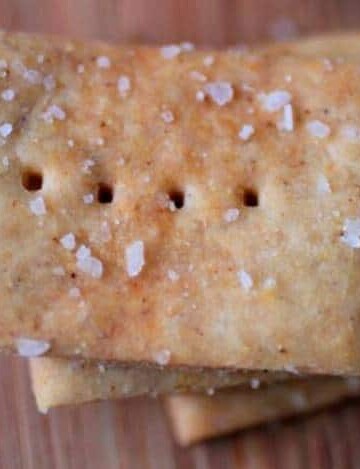
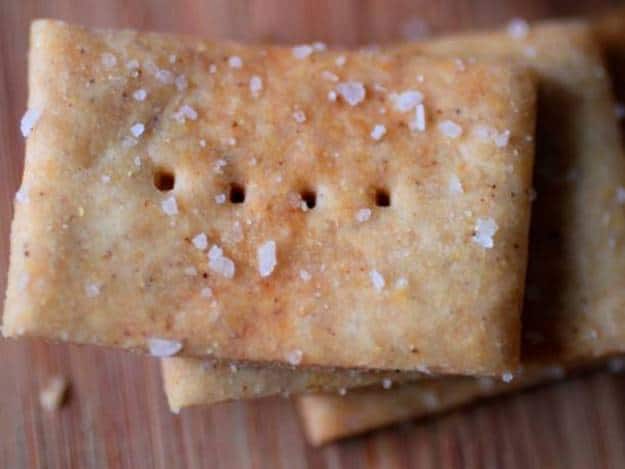
    Whole grain gluten-free crackers with salt on top.

    Whole grain gluten-free crackers with salt on top.

    Have you ever made crackers? Even though my love of crackers began at an early age, I’d never made a batch until I started baking gluten-free. I don’t know why, but making crackers seemed mysterious to me. Turns out, it isn’t mysterious at all!

    Making the dough is easy, especially if you have a food processor. You just need to cut the fat (butter or shortening) into the dry ingredients. Like making a pie crust, this creates little layers of fat that leave the crackers flaky when baked. But crackers need a little more than just cutting the fat into the flour to achieve the correct texture.

    After a few batches, I realized the key to making crackers is rolling the dough thin. Really thin. If you don’t get the dough thin enough, the crackers resemble a savory shortbread more than a true cracker.

    Enter parchment paper! When you roll the dough between two pieces of parchment, you can roll it super-thin without any hassle. After rolling, slide the parchment, dough and all, onto a baking sheet. Then just pull the top piece of parchment away and score the dough. Since the crackers are baked on the parchment, they break apart easily once baked. (And if this technique seems familiar, it’s because we used it to make graham crackers this summer.)

    Made with a combination of brown rice flour and sorghum flour, these crackers remind me a little of Wheat Thins, only better. They’d be perfect with any cheese you might be serving on New Year’s.

    Want flavored crackers? Add about one tablespoon of chopped fresh herbs (rosemary is nice), a teaspoon of freshly cracked black pepper or even a little chili powder—I’d start with one teaspoon and then adjust to suit your taste.

    Whole grain gluten-free crackers with salt on top.
    Print

    Gluten-Free Whole Grain Crackers

    Prep Time 25 minutes
    Cook Time 15 minutes
    Total Time 40 minutes
    Servings 75 crackers
    Author GlutenFreeBaking.com

    Ingredients

    • 3/4 cup sorghum flour (3 3/4 ounces; 106 grams)
    • 3/4 cup brown rice flour (3 3/4 ounces; 106 grams)
    • 1 tablespoon granulated sugar (about 1/2 ounce; 12 grams)
    • 3/4 teaspoon salt
    • 1/2 teaspoon baking powder
    • 4 tablespoons butter or shortening, cold and cut into four pieces
    • 6 tablespoons cold water (3 ounces; 85 grams)
    • Kosher salt for sprinkling

    Instructions

    1. Preheat oven to 400 ° F. In bowl of food processor combine sorghum flour, brown rice flour, granulated sugar, salt, and baking powder. Pulse to combine. Add butter. Pulse until no large pieces of butter remain. Mixture should resemble a coarse meal.
    2. Add water. Run food processor until dough comes together, about 15-20 seconds.
    3. Turn dough out onto a 12x16 parchment piece of parchment paper. Press dough into a rectangle. Lightly dust dough with brown rice flour. Cover dough with a second piece of parchment paper.
    4. Roll dough until it almost covers the entire piece of parchment. It should be about 1/16” thick. Peel top piece of parchment away. Using a pizza wheel or knife, trim uneven sides of the dough. Slide parchment and dough onto a 12 x 18 baking sheet
    5. Score dough into rectangles. A pizza wheel works best for this task. (I cut my crackers into 1 x1/2-inch pieces.). Prick dough all over with a fork. Sprinkle dough lightly with Kosher salt.
    6. Bake until crackers are golden brown, about 15 minutes. Some of the crackers on the edge might over-bake.
    7. Remove pan from oven. Allow crackers to cool. Store in an airtight container for up to one week.


    Gluten-Free Maple Blondies

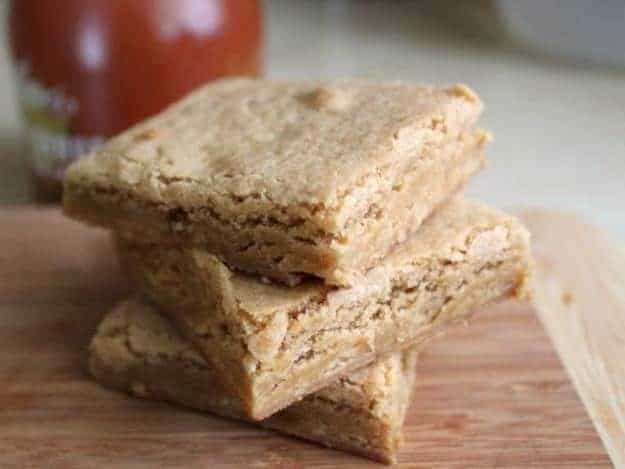
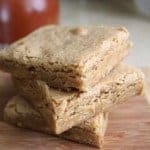
    Gluten-Free Maple Blondies in a stack.

    Gluten-Free Maple Blondies in a stack.

    I live in upstate New York, near the Vermont border, where people take maple season seriously. How seriously? The other day my husband’s co-worker took two days off to boil down 300 gallons of maple sap to get about six gallons of maple syrup.

    While I’ve never made my own maple syrup, I’ve eaten plenty of it. Not only have I poured it on pancakes and waffles, I’ve eaten it in baked beans, pulled pork, desserts of all kinds, and, of course, sugar on snow with a pickle*.”

    Maple blondies, however, might be my favorite way to enjoy maple. These cakey bars, which combine maple syrup, dark brown sugar, and vanilla, are sweet but not cloying. Plus they’re easy to make.

    I used “Grade B” maple syrup in the blondies. This dark grade of maple syrup has a more robust flavor than the more common Grade A. If you can’t find Grade B in your area, don’t fret. Grade A works well, lending the bars a more delicate maple flavor. Just don’t use imitation maple syrup. For these bars, you want the real thing.

    As for the flour, it’s a blend of white rice flour, sweet rice flour and cornstarch. This bland flour blend allows the maple flavor to shine. If you want a nutty/earthy flavor, use brown rice flour in place of white rice flour.

    You might be wondering why I haven’t included walnuts in the bars. Maple and walnuts are a classic combination, but I’m allergic to tree nuts. If you aren’t, add up to 3/4 cup toasted chopped walnuts to the bars. Just remember to alert anyone you serve that the bars contain nuts.

    *Sugar on Snow is made by boiling maple syrup and pouring the hot syrup over, you guessed it, snow. It’s often served with a dill pickle, doughnuts and coffee.

    Gluten-Free Maple Blondies in a stack.
    Print

    Gluten-Free Maple Blondies

    Prep Time 15 minutes
    Cook Time 25 minutes
    Total Time 40 minutes
    Servings 9 or 12 bars
    Author GlutenFreeBaking.com

    Ingredients

    • 1 cup finely ground white rice flour (4 ounces; 113 grams)
    • 1/3 cup cornstarch (1 1/3 ounces; 38 grams)
    • 1/3 cup sweet rice flour (1 1/3 ounces; 38 grams)
    • 1/2 teaspoon salt
    • 1/2 teaspoon baking powder
    • 1/2 teaspoon xanthan gum
    • 1 stick butter, softened (1/2 cup; 2 ounces; 56 grams)
    • 3/4 cup brown sugar (5 1/2 ounces; 155 grams)
    • 1 large egg (1 3/4 ounces; 50 grams)
    • 1/2 cup pure maple syrup (5 1/2 ounces; 156 grams)
    • 1/2 teaspoon vanilla extract
    • gluten-free cooking spray

    Instructions

    1. Preheat oven to 350°F. Spray 9-inch baking pan with gluten-free cooking spray.
    2. In small mixing bowl, whisk together white rice flour, cornstarch, sweet rice flour, salt, baking powder, and xanthan gum. Set aside.
    3. In medium mixing bowl, cream together butter, and dark brown sugar until thick paste forms, about 30 seconds. (Use high speed on handheld mixer or medium-high speed on stand mixer.) Add egg and mix until thoroughly combined.
    4. Add whisked dry ingredients. Blend until smooth, about 30 seconds. (Use medium-high speed with a handheld mixer or medium speed with a stand mixer.) Batter will be dry. Add maple syrup and vanilla. Mix until batter is light and fluffy.
    5. Spread batter evenly into prepared pan. Bake until golden brown, about 25-30 minutes. Remove pan from oven and place on wire rack to cool completely. When cool, Cut into nine or 12 pieces.


    How to Make a Gluten-Free Tart Shell

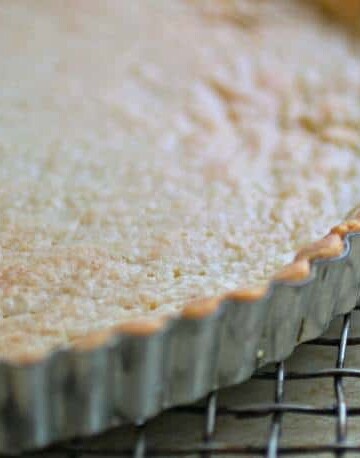
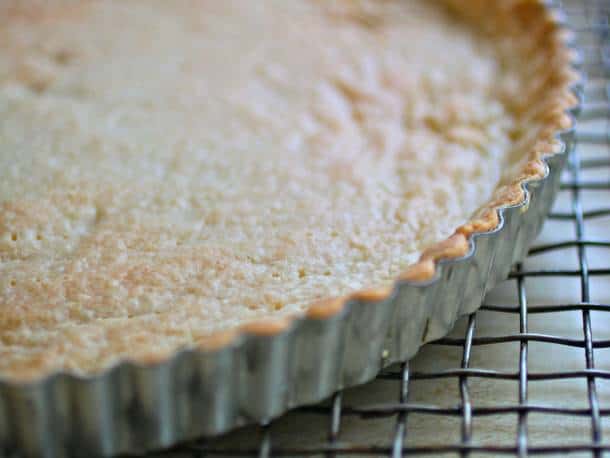
    Gluten-free tart shell in pan on cooling rack.

    Gluten-free tart shell in pan on cooling rack.

    It’s time for dessert!

    Before we begin, here are few notes:

    There are no eggs in the recipe. Thanks to the generous amount of butter, this egg-free tart dough is wonderfully tender.

    Instead of making the dough in a food processor, use a stand mixer. The dough is put together the same way you’d make sugar cookies. And, in fact, the finished texture is very similar to buttery shortbread cookies.

    If you are making a fruit tart, the crust, after a few hours, can get soggy. To avoid this, spread the baked tart shell with melted chocolate. After the chocolate hardens, fill the crust with fresh fruit. The chocolate prevents the crust from getting soggy and adds a nice flavor surprise. If you don’t want chocolate in your tart, make the fruit tart right before serving.  Here’s how to make a sweet tart:Creaming butter for gluten-free tart dough.

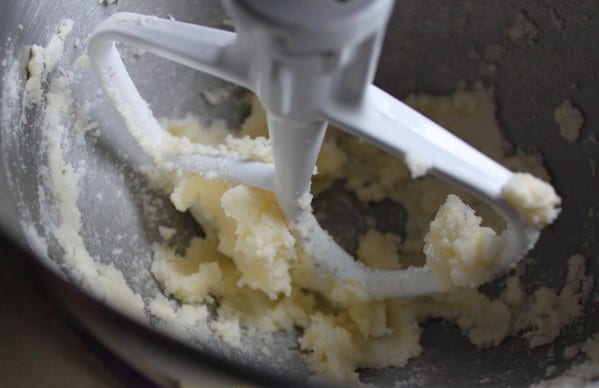
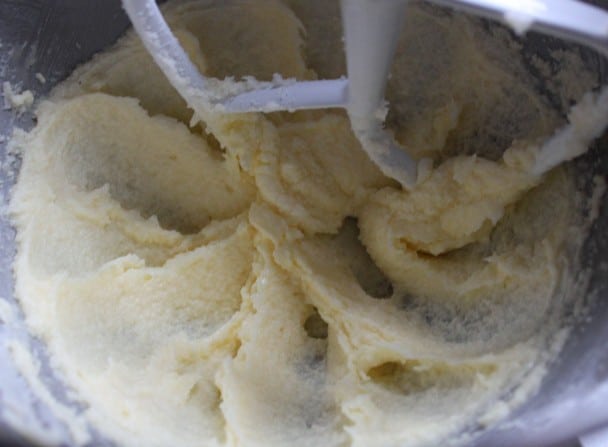
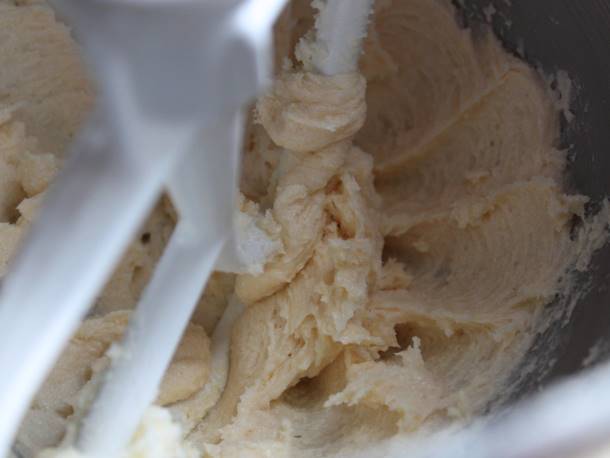
    In the bowl of a stand mixer, cream together the butter, sugar, and vanilla. The mixture won’t get light and fluffy. Rather, it turns into a nice thick paste.

    Dry gluten-free tart dough in bowl.

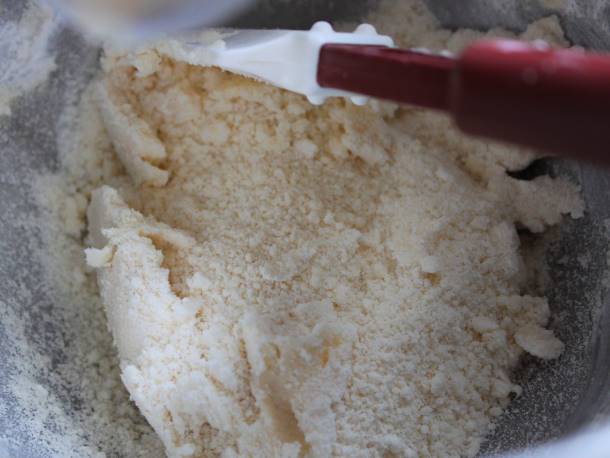
    Add the dry ingredients. At first the dough will be very dry. This is normal. You want to stop the mixer and scrape down the side and bottom of the bowl. Some butter will cling to the bowl. We want that butter in the dough!

    Gluten-free tart dough in stand mixer bowl.

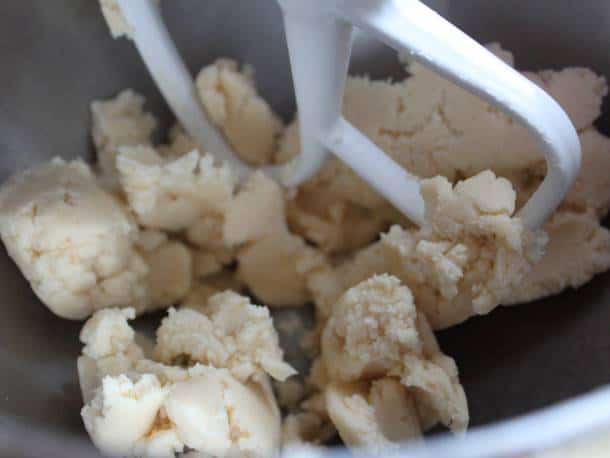
    After about two minutes of mixing, a dough will form.

    Gluten-free tart dough piled into the center of the pan before being pressed out.

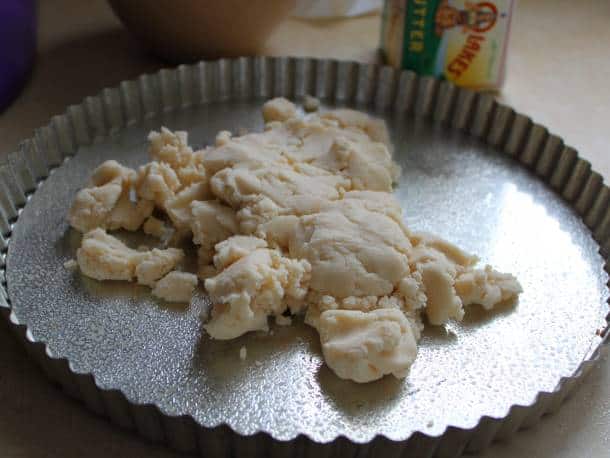
    Transfer the dough to the pan. No rolling required!

    Gluten-free tart dough in pan.

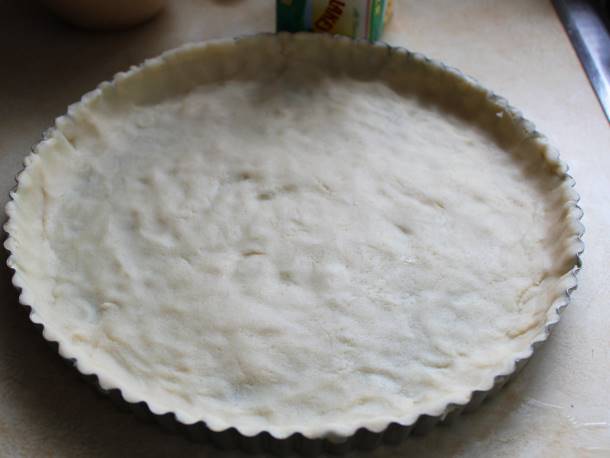
    Press dough into pan, prick bottom of tart with a fork and chill.

    Gluten-free tart shell in pan on cooling rack.

    Bake tart until golden brown. (It will smell nicely of butter and sugar.) Cool and fill as desired.
    Creaming butter for gluten-free tart dough.
    Print

    How to Make a Gluten-Free Tart Shell

    Prep Time 25 minutes
    Cook Time 20 minutes
    Total Time 45 minutes
    Author GlutenFreeBaking.com

    Ingredients

    • 1 cup finely ground white rice flour (4 ounces; 113 grams)
    • 1/4 cup sweet rice flour (2 ounces; 56 grams)
    • 1/2 teaspoon salt
    • 1 stick butter, softened (1/2 cup; 4 ounces; 113 grams)
    • 1/3 cup granulated sugar (1 3/4 ounces; 50 grams)
    • 2 teaspoons vanilla extract

    Instructions

    1. In a small bowl, whisk together white rice flour, sweet rice flour, and salt.
    2. Fit stand mixer with flat paddle attachment. In bowl of stand mixer, cream together butter, sugar, and vanilla on medium speed until a thick paste forms and mixture lightens slightly, about 90 seconds. Add dry ingredients and mix for 30 seconds. Mixture will be dry and crumbly.
    3. Stop mixer and scrape down bowl. Turn mixer back on to medium speed. Mix until a dough forms, about two minutes.
    4. Lightly spray 11-inch tart pan with non-stick cooking spray. Turn dough into prepared pan. Using your hands, press dough evenly into bottom and sides of pan. Prick dough all over with a fork.
    5. Cover pan with plastic wrap and chill for two hours.
    6. Preheat oven to 375°F. When oven is preheated, remove tart pan from refrigerator. Pierce bottom and sides with a fork. Bake until golden brown, about 20 minutes. Remove pan from oven and place on wire rack to cool.


    Gluten-Free Shortcakes

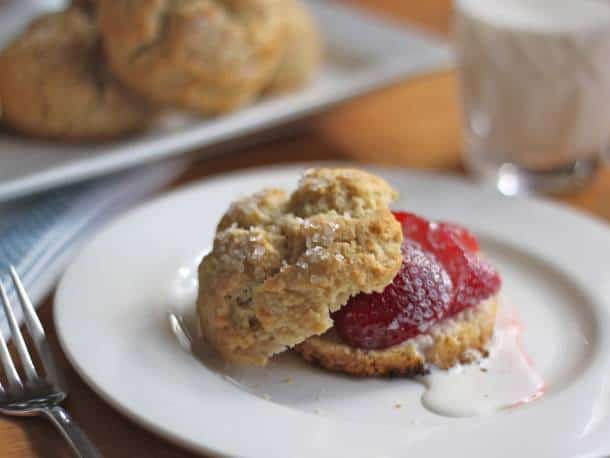
    Gluten-Free Shortcake, split and topped with strawberries and a drizzle of cream.


    Gluten-Free Shortcake, split and topped with strawberries and a drizzle of cream.

    If I close my eyes, I can hear it: the call of summer berries. OK, maybe that’s just my stomach talking but nonetheless it’s berry season. And you know what that means—it’s shortcake season!

    Shortcakes are really just sweetened biscuits. A few weeks ago we made cheddar biscuits. The technique for this recipe is the same: cut cold fat into flour, add liquid (in this case heavy cream) and drop the finished dough onto a baking sheet.

    Most traditional (read: wheat-filled) shortcakes, use white flour. I wondered how shortcakes made with a blend of whole-grain flours might taste. Would the mild, nutty flavor of the brown rice and sorghum enhance or overpower the delicate berries?

    Turns out, the flours nicely enhanced the flavor of the finished shortcake. A few of my tasters thought the whole-grain version contained more vanilla than the shortcakes baked with white rice flour. The recipe didn’t contain any vanilla extract! I think the combination of whole-grain flours added a fragrant, earthy tone that they mistook for vanilla. This was a happy surprise.

    If you prefer a traditional shortcake, replace the brown rice and sorghum flour with white rice flour. I’ve made the recipe both ways and love both versions.

    Allergen Notes:

    Dairy is the only “top eight” allergen this recipe contains. To make the shortcakes dairy-free, replace the butter with a solid dairy-free shortening and the half and half with a dairy-free replacement. Full-fat coconut milk works well. Be sure to whisk the coconut milk into smooth. You want the fat from the top of the can fully incorporated into the milk before you measure.


    Gluten-Free Shortcake, split and topped with strawberries and a drizzle of cream.
    Print

    Gluten-Free Shortcakes

    Prep Time 30 minutes
    Cook Time 20 minutes
    Total Time 50 minutes
    Servings 14 biscuits
    Author GlutenFreeBaking.com

    Ingredients

    • 1 1/4 cups sorghum flour (6 ounces; 170 grams)
    • 1 cup brown rice flour (5 ounces; 142 grams)
    • 1 cup potato starch (4 ounces; 113 grams)
    • 3/4 cup tapioca starch (3 ounces; 85 grams)
    • 6 tablespoons granulated sugar (2 2/3 ounces; 73 grams)
    • 2 tablespoons baking powder
    • 3/4 teaspoon salt
    • 1/4 teaspoon xanthan gum
    • 1 1/2 sticks unsalted butter, cut into small pieces
    • 1 1/2 cups cold half and half (or 3/4 cup whole milk, 3/4 cup heavy cream) (12 ounces; 340 grams)
    • Coarse sugar for sprinkling on top of shortcakes optional

    Easy Strawberry Shortcake

    • Strawberries hulled and sliced
    • Confectioners' sugar
    • Heavy cream or whipped heavy cream

    Instructions

    1. Make the Shortcakes: Adjust oven rack to middle position. Preheat oven to 425 degrees F.

    2. In bowl of food processor, pulse together sorghum flour, brown rice, flour, potato starch, tapioca starch, granulated sugar, baking powder, salt, and xanthan gum. (Don't have a food processor? Use a medium bowl and whisk ingredients together.)

    3. Add butter. Cut butter into dry ingredients by pulsing food processor a few times. Butter pieces should be about the size of a small peas. (If doing this by hand, cut shortening and butter into the dry ingredients with either a pastry cutter or by rubbing the fat into the dry ingredients with your hands.)
    4. Add half and half. Pulse food processor until dough forms. (Stir to combine if doing this by hand.) As soon as dough comes together, stop food processor.
    5. Drop dough, about 1/4 cup each, onto prepared baking sheet. If desired, sprinkle tops of shortcakes with coarse sugar. Bake until shortcakes are golden brown, about 20 minutes.
    6. Remove shortcakes from pan and place on wire rack to cool.
    7. Make Easy Strawberry Shortcake: Toss sliced strawberries with confectioners' sugar. Allow berries to stand for about five minutes. Split shortcake in half. Top shortcake with berries and drizzle with cream or spoon whipped cream on top of berries.


    White Chocolate Blueberry Oatmeal Cookies

    Gluten-free white chocolate oatmeal cookies.

    Gluten-Free White Chocolate Oatmeal Cookies

    Oh, raisins. I’ve tried and tried to like them. At this point, I can tolerate a few especially if they are dipped in chocolate but in general I avoid them. This means I’ve turned down more than one oatmeal cookie because of the raisin element—and don’t get me started on the times I mistook raisins for chocolate chips. Let me tell you, sorely disappointed doesn’t even begin to describe how I felt.

    Since I like other dried fruit, I wasn’t ready to let the oatmeal cookie-dried fruit combo go. One day I threw a handful of dried blueberries into a batch of oatmeal cookies. Oh my. I finally got it. There’s something wonderful about the chew and sweetness of dried fruit paired with the nutty-grain flavor of oatmeal.

    And because a little chocolate is never a bad thing, I started adding chocolate chips to the cookies. For these cookies, I like white chocolate chips but any chocolate will do.

    Of course, if you don’t like dried blueberries, you could always use raisins…

    A word about oats. Some gluten-free eaters avoid oats. If you include oats in your gluten-free diet, be sure to use oats that are specifically marked gluten-free.

    Gluten-free white chocolate oatmeal cookies.
    Print

    White Chocolate Blueberry Oatmeal Cookies

    Prep Time 20 minutes
    Cook Time 18 minutes
    Total Time 38 minutes
    Servings 24 cookies
    Author GlutenFreeBaking.com

    Ingredients

    • 1 1/4 cups brown or white rice flour (6 ounces; 170 grams)
    • 3/4 cup sorghum flour (3 3/4 ounces; 106 grams)
    • 1 teaspoon baking soda
    • 1/2 teaspoon salt
    • 1/4 teaspoon xanthan gum
    • 1 1/2 sticks unsalted butter, softened (6 ounces; 170 grams)
    • 1 1/4 cups brown sugar, packed (9 1/3 ounces; 263 grams)
    • 2 large eggs (3 1/2 ounces; 100 grams)
    • 3 cups gluten-free oats (12 ounces; 340 grams)
    • 1 cup dried blueberries (5 1/2 ounces; 155 grams)
    • 1 cup white chocolate chips (6 ounces; 170 grams)

    Instructions

    1. Adjust oven rack to the middle position and preheat oven to 350°F. Line a baking sheet with parchment paper.
    2. In a medium mixing bowl, whisk together rice flour, sorghum flour, baking soda, salt, and xanthan gum. Set aside. In bowl of stand mixer, cream together butter and brown sugar on medium-high speed until light, about 45 seconds. Add eggs, one at a time. Mix until well combined and sugar-egg mixture lightens slightly, about 25 seconds.
    3. Turn off mixer and add whisked dry ingredients. Turn mixer back on to medium-low. Mix until a dough forms. The dough will be soft. Turn off mixer. Add oats, blueberries, and white chocolate chips. Turn mixer back on to medium-low. Blend until ingredients are thoroughly mixed throughout the dough.
    4. Chill dough for five minutes. Scoop dough, about one tablespoon each, onto prepared baking sheet. Bake until cookies are golden brown and set, about 18 minutes. Remove pan from oven. Allow cookies to cool on the baking sheet for three minutes before transferring to wire rack to cool. Allow pan to cool between batches. Repeat with remaining dough.


    • « Go to Previous Page
    • Page 1
    • Interim pages omitted …
    • Page 17
    • Page 18
    • Page 19
    • Page 20
    • Go to Next Page »

    Primary Sidebar

    Get Recipes Delivered to Your Inbox! (Free Weekly Newsletter!)


    Elizabeth Barbone

    I'm Elizabeth. Welcome to GlutenFreeBaking.com --- a judgment-free baking space. Here you'll find easy recipes, product reviews, and other good stuff that makes gluten-free living easy and a lot more fun!

    Read More About Elizabeth →

    • Facebook
    • Instagram
    • Pinterest

    Foods You Miss the Most

    • A stack of gluten-free pancakes topped with maple syrup and butter on a plate.
      The Best Gluten-Free Pancakes
    • Gluten-free chocolate chip cookies on a cooling rack.
      Gluten-Free Chocolate Chip Cookies
    • Loaf of Baked Gluten-Free Sandwich Bread on Red Cutting Board.
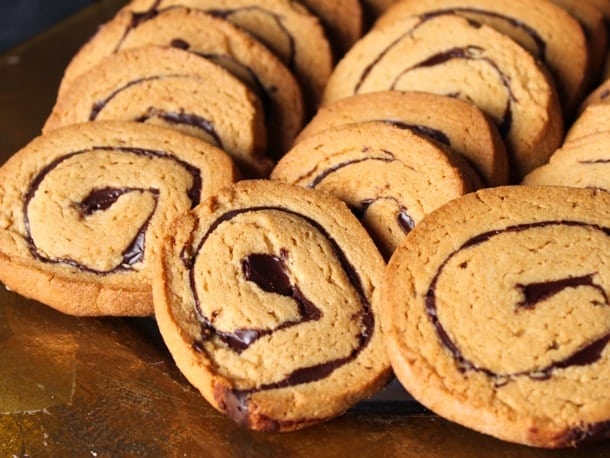
      How to Make the Best Gluten-Free Sandwich Bread: An Easy Recipe for Everyone!
    • Gluten-free flour tortillas on plate.
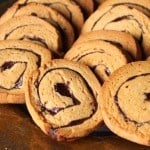
      How to Make the Best Gluten-Free Flour Tortillas

    Footer

    ↑ back to top

    Terms

    • Privacy Policy
    • Terms & Conditions
    • Disclaimer
    • Accessibility Statement

    Follow Us

    • Facebook
    • Instagram
    • Pinterest

    About

    • Contact
    • About

    Copyright © 2026 Gluten-Free Baking